
Yalla Falasteen
Revitalization Program
As-Sātūn Mosque

As-Sātūn Mosque (Visiting time is open, free entry)
As-Sātūn mosque is in al-Yāsmīnah quarter. This had been the first mosque to be established after the conquest of the city in the first Islamic era. For this reason it is nicknamed as “al-'Omari Mosque”. Later on, the northern part of the current building had been expanded. Rising from the mosque is a twelve-sided minaret with a stone balcony. It is believed that the minaret had been built in 1515 AD.
Various inscriptions are likely to be noticed in a number of places within the mosque. The information they contain is brought together in a single calligraphy to the right of the entrance of the prayer room. It reads:
“In witness to the date shown in the As-Sātūn mosque square, it is clear that the martyr, Jamāl ad-Dīn Nūr Allah Ibn Shams ad-Dīn, God bless him, who had built al-'Umari mosque in 688 AH, and that the place for ablution and the present prayer room had been built at the time of al-Hāj Sadaqah al-Khudari, God bless him, in Rajab 798 AH. But the old minaret before the current one was built at the time of the martyr Mohammad Ibn 'Imād ad-Dīn in Rabī' al-Awwal 759 AH.”
Historical section
Attribution of the building (identification): The attribution of this mosque was verified by a group of historical inscriptions, and the Satoun Mosque was mentioned in the records of the Nablus Sharia Court. In the year 1101 AH/1689 AD, Sheikh Abdul Ghani al-Nabulsi visited the Satoun Mosque and said: “We went to the Satoun Mosque and were blessed by the relics of the righteous.” However, Sheikh al-Nabulsi did not clarify the nature of the righteous and their relics, although he believes that they are the achievements of the work of the members of the al-Shahid family in rebuilding and restoring the mosque over their successive generations. Al-Nimr mentions that the Muslims built a mosque in place of a Frankish temple, which they called the Mosque of Al-Satun, and they found that the Franks had converted it into a church. It is understood from what he said that the mosque existed before the Frankish occupation of Nablus in 492 AH/1099 AD, and that the Franks converted it into a church. However, after the Muslims liberated the city from the Franks, they converted the church into a mosque. However, there is nothing to support this statement historically or archaeologically in the building of the mosque, especially since Al-Nimr did not mention the historical source on which he relied. It is most likely that the mosque continued as a mosque since its founding and during the Frankish era of the city, and it was not converted into a Frankish church.
History: Based on a group of previously unpublished inscriptions, which the author of these lines has studied. They are still standing in the mosque’s corners, it is possible to trace and monitor several stages of the development of this mosque. If we rely on the first inscription above the mihrab of the northern courtyard, the nucleus of this mosque is likely to date back to the beginning of the Islamic conquest, as the mosque was considered to be of Umayyad proportion, meaning that its foundation and first construction date back to the era of the Rashidun Caliph Umar ibn al-Khattab (13 AH/23 AH/634-644 AD), and that the mosque was renovated by Jamal al-Din Nur al-Umara ibn Shams al-Din ibn al-Tahir ibn al-Shahid in the year 688 AH/1288 AD during the Mamluk era. Although the inscription does not specify the nature of the renovations, the ceiling of the prayer hall, the stone pillars in the middle of it, and the stone dam located north of the prayer hall can be attributed to this period. This inscription is made of marble, measures 70 cm by 48 cm, and is written in Mamluk Naskh script and consists of five lines (Figure (1)).

Figure (1): The marble stone carving in the courtyard of the Satun Mosque
A second marble inscription indicates the construction of a minaret in the mosque by Muhammad ibn Imad al-Din Ibrahim al-Shahid in 759 AH/1358 AD. The inscription consists of four lines in Mamluk Naskh script, measures 80 cm by 50 cm, and stands above the southern entrance to the current minaret. A third inscription above the northwestern arch of the open northern courtyard dates back to a construction phase that took place in 798 AH/1399 AD by Hajj Sadaqa al-Husri. Although the text refers to the construction as a place, the construction of the stone dam located inside the north of the prayer house can be attributed to this construction, as its architectural character is represented by its south resting on a series of circular arches that in turn rest on the stone pillars in the middle of the prayer house. The records of the Nablus Sharia Court refer to this stone dam in 1066 AH/1655 AD, when it recorded the appointment of Sheikh Salah al-Din ibn Sheikh Muhammad ibn Shahwan to the position of reading the tenth of the Holy Month on the dam of the Satun Mosque. In 1099 AH/1687 AD, an iwan was built on both the western and eastern sides of the open northern courtyard of the Satun Mosque by order issued by the Sharia judge of Nablus to the trustee of the Satun Mosque endowment, Sheikh Fakhr al-Din Sharaf al-Din. He stipulated that a door be opened for the mosque in them and that a stone staircase be built to reach the back of the two aforementioned iwans, and that the stones for their construction be taken from the demolished stones in the Green Mosque. A fourth stone inscription found above the entrance to the pulpit inside a stone rectangle 34 cm long and 56 cm wide, consisting of three lines of writing in the local Naskh script, indicates that it was rebuilt again in 1269 AH/1852 AD during the Ottoman era. The founder and the builders: It is not known with certainty who founded the first nucleus of the mosque, but if it is considered to be Omari, this means that it is attributed to Omar bin Al-Khattab, but there are a number of inscriptions that mention between their lines a number of those who contributed to the construction of the mosque, including Nour Al-Umara Jamal Al-Din bin Shams Al-Din Al-Tahir Al-Shaheed, and Muhammad bin Imad Al-Din Ibrahim Al-Shaheed, who built a Mamluk minaret in 759 AH / 1357 AD. This means that the Al-Satun Mosque was of special interest to members of the Al-Shaheed family in Nablus. Among those who contributed to the construction of this mosque was Hajj Sadaqa Al-Husri, and although there is no historical information available about him, it can be assumed that he was one of the city’s notables and wealthy people.
Later History (Modern):
It is worth noting here that the historian Al-Nimr mentioned that the current minaret of the mosque was built three quarters of a century ago and that it was built by the teacher Abu Saeed Al-Sarwan.
Architectural Description: (Figure (1))
External Description: The mosque is surrounded by three external facades, while it is bordered and adjacent to it from the eastern side by a group of residential floors, and the southern facade of them overlooks the main street (Al-Masaban Street) along the length and height of the prayer house, where it forms at the same time the southern border of the mosque, and this facade consists of small stones in the local construction style and at the top of it are the openings of the prayer house windows. As for the western facade, it overlooks the other main street in this direction. The southern section of it is supported by the arch of the western main street, below which in this section of the facade are two entrances with a stone pillar separating them from each other, and the first of them, the southwestern entrance, leads directly to the prayer house from the main street, while the second entrance leads to a threshold from which a few steps are reached and then to a small step leading to the prayer house and then breaks slightly north to lead to the open northern courtyard of the mosque. In the northwestern section of this external western facade, where the northwestern facade of the mosque is located, there are two adjacent arched fountains below it, which are known as the Ran fountain or the Satun Mosque fountain. While the northern external facade is a simple facade and is mostly rebuilt in a local style.
Internal description: A door opening onto the main street forms the southwestern entrance to the mosque, leading directly to the rectangular prayer house extending from east to west. The prayer house is surrounded by four square stone pillars that divide it into two northern and southern corridors, and carry circular stone arches that support a stone dam north of the prayer house (Figure (3)), which dates back to the third Mamluk construction period. Three niches and a stone pulpit are located in the southern wall of the prayer house, and a group of arched windows rise above the southern wall, while the prayer house is covered by intersecting vaults that rest on a series of pointed stone arches, thus bearing the character of Mamluk architecture with roofing. The other northwestern entrance from the main street leads to an open northern courtyard, to the south of which are small entrances leading to the prayer house. Next to the middle one is a small stone mihrab topped with a marble inscription. On both its eastern and western sides is a large iwan overlooking it with a pointed stone arch opening. In the middle of the northeastern iwan is a large cylindrical stone column on which the vaulted ceiling supports its own, while in the northeastern corner of this iwan there is a stone staircase that breaks to the right of the ascender to lead to the stone barrier inside the prayer house. On the western side of the open courtyard there is another iwan, which is the northwestern iwan of the mosque, inside which is the imam’s room and the ritual bath. Meanwhile, at the northern end of the open courtyard there is a 3m-high stone wall of simple construction. In the northwestern corner of the top of the prayer house, adjacent to the southern section of the roof of the northwestern iwan, there is a minaret whose square stone base is reached from inside the prayer house by a stone staircase leading to the stone dam to the east and west to the base of the minaret where its small southern entrance is located, topped by a Mamluk inscription in marble. Then the base is topped by a polygonal body that ends with a stone balcony in the middle of which is a small dome.
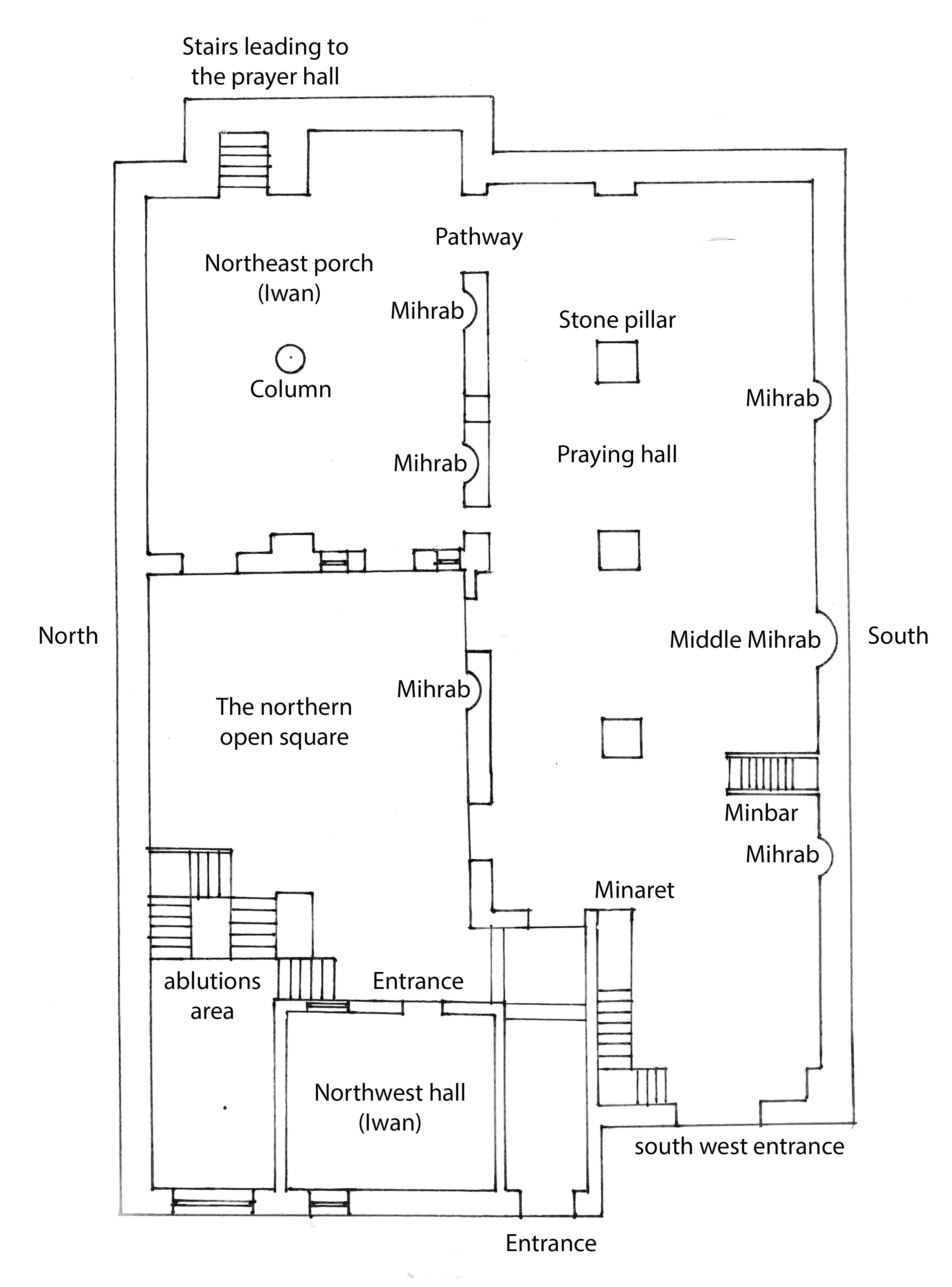
Figure (2): Ground floor plan - Al-Satoun Mosque

Figure (3): The Qibla wall and the prayer hall in Al-Satoun Mosque