Yalla Falasteen
Revitalization Program
Soap Factories
Soap factories in Old Nablus
The old city of Nablus is distinguished by the presence of a large number of soap factories within its traditional urban fabric. During the eighteenth and nineteenth centuries, most of the soap factories were located in the neighborhoods of Habala, Yasmina and Gharb. With the increase in demand for Nablus soap and the flourishing of its industry during the last quarter of the nineteenth century, the city witnessed an increase in the number of soap factories operating in it, and their number doubled between the years 1860 and 1882, until the entire city became like a large soap factory. Most of the production became concentrated in the southern and western parts of the city, near what is now known as Soap Street. In 1860, the number of soap factories operating at full capacity in Nablus was 15, and in 1882 their number became thirty. During World War II, the number of soap factories operating at full capacity in Nablus was 29, of which 23 were large and the rest were small (Domani, 1998: 304-305). To understand the importance of the soap industry in Nablus in the latter half of the nineteenth century, it is sufficient to know that Palestine was the largest source of soap in the Fertile Crescent, and that the doubling of soap exports from Palestine during the sixties and seventies of the nineteenth century coincided with the doubling of the number of Nablus soap factories, and that Nablus alone had 30 soap factories out of the total number of forty soap factories in Palestine at that time (Domani, 1998: 308). When studying the distribution of soap factories in the old city of Nablus, it is noted that they are present in all neighborhoods without exception, with a high concentration in the south of the city around the soap factory street. These huge buildings have elegantly integrated into the urban fabric of the old city, and have become important components that distinguish the old city and give it a unique character. The architectural design of the soap factories has maintained the special and distinctive traditional features of these buildings, which are completely in line with the function for which they were built, just as Nablus soap has maintained its traditional ingredients, manufacturing method and quality to this day.
Perhaps the use of natural materials in soap making was the reason behind the absence of unpleasant waste or unpleasant odors during the manufacturing process, as there was no obstacle to establishing soap factories within the residential neighborhoods of the old town, but rather they were found adjacent to the homes of their owners, as the house of the soap factory owner was built above it or near it and adjacent to it.
Although the soap factories followed a specific design pattern, the old town contained examples with unique features, such as the presence of two floors for soap spread in the Qaraman (Abu Al-Rus) soap factory, and the presence of a mat on the ground floor in the Canaan soap factory, which was completely destroyed during the Israeli invasion of Nablus in 2002. The Canaan soap factory was a unique example, distinguished by a rich horizontal plan and different in its design from the rest of the soap factories in the city, as it contained two mats for spreading soap on the ground floor, in addition to the main mat on the first floor. It was also distinguished by the fact that the staircase connecting the ground floor to the first floor was wide, well-lit, and open to the ground floor through an opening topped by a semicircular arch. It also differed in the way the building was entered through a square space roofed with a crossed arch leading to a small open courtyard through which one could reach the entrance to the soap factory, and also to the residence of the soap factory owner, located above it, via a narrow and long staircase.
Nablus is the centre for the soap industry to the extent that this product carried its name. The number of soap factories in Nablus is forty-three distinct soap plants or factories. Six adjacent soap factories gave the street connecting between al-Qaryūn and al-Yāsmīnah quarters its name. That is al-Masābin street - street of the Soap Factories -. The Soap factories were established within residential dwellings. They can be identified by their huge gates and large windows in the upper floor. Undoubtedly, soap production represents an important part of the Nabulsi cultural heritage as well as of its economy.
Architectural description of the soap factory building
It is noticeable that the soap factories found in the city of Nablus combined architectural form and function in their design. Although these buildings were built primarily for a specific function, which is soap manufacturing, they contained carefully and beautifully designed spaces, and sometimes architectural details appeared in them, such as decorations above the entrance, or stone arches inside, or niches in the walls. The soap industry was confined to the city's families with prestige, power and influence, so the soap factory buildings came to reflect these connotations, albeit indirectly.
Although the buildings of the old city of Nablus were characterized by their openness towards the inside and that they were built around open courtyards around which the rooms and various spaces of the building were lined, the architectural design of the soap factories relied on the building's openness to the outside, in a way that shows the close relationship between the building and the street through the direct entrance and windows overlooking the outside. (Figure (1))
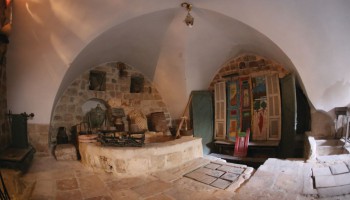
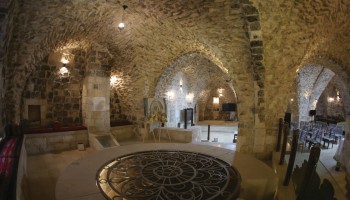
The soap factory building is characterized by being huge and having a large entrance, designed to facilitate the entry of loads of raw materials used in soap making, such as oil, alkali, sidr and gypsum, and the exit of the soap ready for sale. The soap factory building consists of two floors, the ground floor is wide and dark and has a high ceiling consisting of intersecting arches supported by very large columns, the cross-sectional area of the column is about 1.5 to 2 square meters. The columns divide the open interior space into equal parts, and there are no walls on the ground floor except those that define the office of the soap factory owner. The most important function on the ground floor is cooking soap, which occupies the largest part of it. There are also side spaces for storing fuel and raw materials and huge underground wells for storing olive oil, which have openings in the soap factory floor from which the oil can be drawn using special buckets.
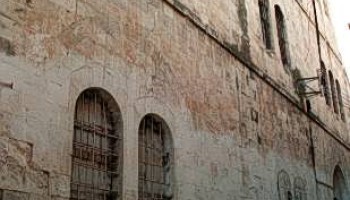
The first floor or the carpet was designed to suit the function for which it was used, which is to spread out the cooked soap, cut it and dry it. The first floor is wide and open, and it is a space with nothing but huge columns that support the intersecting arches. Although the height of the first floor is lower than the ground floor, the windows on this floor are large and occupy most of the facade of the soap factory overlooking the street. They were therefore designed to help bring in air and speed up the drying of the soap. As for the stairs that connect the floors to each other, they were high, narrow and dark, and the workers had to climb the slippery stairs many times carrying buckets filled with cooked soap to spread on the floor of the carpet. The main material used in building soap factories is limestone, which is the traditional building material in Palestine and is used in all the buildings of the old town. The stone was used in building thick walls with a depth ranging on average between 100-120 cm, and it was also used inside to build stone arches and arches.
.jpg?_t=1724839427)
Figure (1): A three-dimensional drawing showing the different parts of the soap factory, source: (Amad, 1997)Figure (1): A three-dimensional drawing showing the different parts of the soap factory, source: (Amad, 1997)
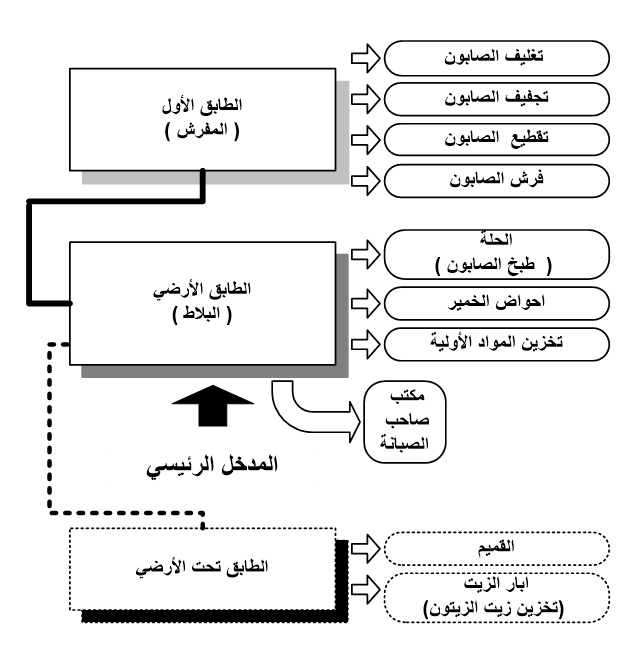
Figure (2): A schematic diagram showing the different levels of the soap factory and the functions performed at each level.
External facades of soap factories
The first thing that is noticed in the main facade of the soap factory is the presence of large openings for the cover located on the first floor of the building. The design of the facade shows the strong relationship between the building and its external surroundings, and this is clearly evident through the presence of the cover windows that occupy the entire space available structurally between the huge columns and the upper arches extending between them. The soap factories buildings can be identified from the outside by observing the cover windows that stand out within the traditional style of openings in the facades of the old town, which are characterized by the dominance of solid spaces.
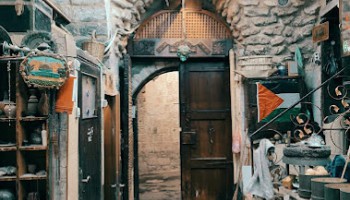
One of the important elements in the soap factory facade is the large entrance that was carefully designed to indicate the importance and value that these buildings enjoyed. The details of the entrance differed from one soap factory to another, as most of them showed a door opening topped by a motorized arch and crowned at a higher level by a pointed arch. While the design was characterized in most cases by simplicity, sometimes stone details and decorations appeared in the arch that crowns the door opening.
The ground floor windows are few and small in size compared to the windows of the awning. If the owner of the soap factory lives on an upper floor above it, relatively small windows appear on its facade to suit the function and provide the privacy required in residential buildings. Thus, the facades of the soap factories clearly reflect the difference in function occupied by each level in the building.
Soap manufacturing
The basic materials needed for producing soap are olive oil, water, salt, al-Qili (the alkaline ash of the ash-Shīh plant from the Jordanian desert - the Arabic word is the origin of the English word alkali-), and lime. Traditionally lime was mixed with the al-Qili to produce an alkaline liquid. More recently, al-Qili has been replaced by sodium hydroxide that has the same effect. The two soap factories in the centre of Nablus, Tuqān and Shaka’a are still producing soap in the traditional, conventional manner. Several other soap factories have been refurbished and they currently have various uses. They can be visited to have a glimpse of the production of soap and benefit from their modern uses
.JPG?_t=1724839279)
Figure (3): Al-Nabulsi Soap Factory Facade, Al-Qaryoun District

Figure (4): Nabulsi soap stacks