
Yalla Falasteen
Revitalization Program
Al-Khadrah Mosque

Al-Khadrah Mosque (Visiting time is open, free entry)
Al-Khadrah mosque is in the south western part of the old city. It is nicknamed as as-Sultān Mosque on behalf of the Mamluk Sultān, Sayf ad-Dīn Qalāwūn. The rectangular prayer room is completely open. There are no columns to support the roof. Instead, it is designed in three perpendicular cross vaults which protrude from the walls. The design of the roof is distinguished by the presence of hanging vaults.
It is believed that there had been first a small maqam (shrine) in the site. This site is where the Crusaders built a church. Later, it had been transformed into a mosque during the Ayyubids dynasty. Later on, the rulers of the Mamluks dynasty had renovated it as is indicated in the inscription on the stone above the main entrance of the mosque.
Among these works, there had been the construction of the squared minaret at the northern side of the mosque.
Historical section:
Attribution of the building (identification): The Green Mosque was mentioned by the Turkish traveler Jalabi, who visited the mosque in 1082 AH/1671 AD and stated that it was “a square-shaped building with a side length of eighty-seven steps.” Sheikh Abdul Ghani al-Nabulsi also visited it in 1101 AH/1689 AD and recorded a beautiful, detailed description, which reads: “We entered an old mosque with dilapidated sides and corners. It had large pools of water, with square sides equal to the ground, and water flowed from the mouths of its canals. Around it were trees, orchards, and flowers. In front of the pool was a mosque for prayers.” Sheikh Mustafa Asaad al-Laqimi visited the mosque in 1143 AH/1730 AD, where he stated that there was a place in it called Khalwat al-Makhzun. The attribution of this mosque was established by a group of architectural and decorative elements, and a written marble inscription that will be discussed below in (History).
History: The architectural fabric of the Green Mosque indicates that its core was a Frankish church founded during the Frankish occupation of Nablus (492-583 AH/1099-1187 AD). All that remains of it is the lower section of the northern outer wall and the intersecting stone arches of the prayer house. It seems that the Ayyubids converted this church into a mosque in 583 AH/1187 AD. It is clear from the marble inscription above the northern central entrance to the prayer house that the mosque was rebuilt during the reign of Sultan Sayf al-Din Qalawun al-Alfi (678-689 AH/1279-1289 AD) and his crown prince, his son, King al-Salih Ala al-Din. What can be attributed to this construction campaign is limited to the construction of the square minaret and the group of three entrances with their arches and decorations located in the northern outer wall of the prayer house. It is clear that in 1099 AH/1687 AD, based on a legal argument, some of the mosque’s pillars were demolished without disrupting the performance of prayer, which prompted the legal judge to allow the trustee of the Al-Khadhra and Al-Satun Mosques’ endowments to use the demolished stones to build two shelters in Al-Satun Mosque. Accordingly, this demolition occurred after the Turkish traveler visited the mosque. This demolition was confirmed by Sheikh Abdul Ghani Al-Nabulsi, who visited the mosque in 1101 AH/1689 AD. However, he did not refer to this Sheikh Al-Laqimi, which suggests that the mosque was renovated between the visits of Sheikh Al-Nabulsi and Sheikh Al-Laqimi (see above for the building’s proportions). This is supported by the construction of the top of the northern outer facade of the prayer house, i.e. in the first half of the twelfth century AH/eighteenth century AD. In 1185 AH/1789 AD, the top of the minaret was damaged as a result of Sheikh Zahir al-Umar attacking Nablus. It seems that the mosque as a whole was also affected by this, which led to its destruction and lack of reconstruction. Despite this, prayers were not interrupted in it.
The founder and the builders: The site is very old and it is not known who founded it for the first time. The Green Mosque is linked to some stories about the Samaritans, which were recorded by the English surveyors in 1880 AD. They believe that they had a previous synagogue in the mosque area.
Later history (modern): The historian Al-Nimr mentioned that the top of the mosque’s minaret was destroyed in 1185 AH/1789 AD, and it remained this way until the Nablus Endowments Department rebuilt and repaired it in 1965 AD. Recently, charitable people placed a wooden pulpit in it and rebuilt the top of the minaret where the small dome is. In 1966 AD, the descendants of the mosque’s endowment trustee built residential buildings on the northern side of the open courtyard and around the mosque’s minaret, which was separated from the architectural sections of the mosque because of that. The mosque was rebuilt in 2004 AD after the Israeli occupation occupied the city of Nablus and demolished the western section of the prayer house, and thus it was rebuilt anew on that date.
Architectural Description
External Description: The eastern entrance is a simple building with a high and arched structure in a local style leading to a long and wide open corridor, confined between two northern and southern walls where orchards are in both directions. At the western end of this corridor, there is a stone staircase leading to a simple entrance covered by a cement canopy that leads to the open northern courtyard, in the southeastern corner of which is a group of Islamic graves dating back to the late Ottoman Turkish era and the British Mandate era. On the northern side of the open courtyard is a high cement wall behind which is a group of residential floors that were built in 1966 AD. They are five floors or houses attached to the minaret building to the south and east. This minaret was originally located in the northwestern corner of the open courtyard, but it has now been separated from it due to the construction of these floors. This minaret (Figure (1)) consists of a square base, to the southern side of which is a stone staircase that breaks towards the east, leading to the small entrance of the minaret. At the top of the northern side of this square base is a stone inscription that was reused here, measuring 80 cm in length and 50 cm in width, consisting of ten lines in the ancient Aramaic script and language, and includes several religious commandments. Above this square base are four sections that form the square-shaped body of the minaret, separated from each other by an architectural frieze, and above them is a stone balcony with a small dome in the middle. In each side of these four sections, a small rectangular window was opened with two small, double, cut arches. On the western side of the open courtyard, there is a newly built room and ablution areas. There is also a stone staircase that is broken to the right and left leading to the western external entrance where Al-Ain Street is located. It is a very high entrance, approximately 2.5 m above the ground of the open courtyard, which is paved with stone tiles of various sizes. In the middle of it is an octagonal marble pool with a marble fountain in the middle. On the southern side of the open northern courtyard, there is the outer wall of the prayer house. The stones of the lower section of it are distinguished by their large size and precise leveling. They date back to the era of the Frankish occupation of the city of Nablus. As for the upper section, it is distinguished by the small size of its stones. Three entrances are distributed in this wall, symmetrical in construction, design and decoration. Each of them consists of a rectangular entrance opening flanked on both its eastern and western sides by a small stone pillar that rises slightly above the ground of the entrance. Above this opening is a straight stone lintel made of a single piece, followed by two rows of small stones supporting the base of two pointed stone arches, the first of which recedes from the second, and above them is a decorative arch, as each of its stones is decorated with a geometric and plant circle, and its eastern and western ends extend in a straight and decorated manner to connect with the decorative arch of the other eastern and western entrances. The middle entrance is considered the most important of them because above its entrance opening is the written marble engraving that has been discussed in history.
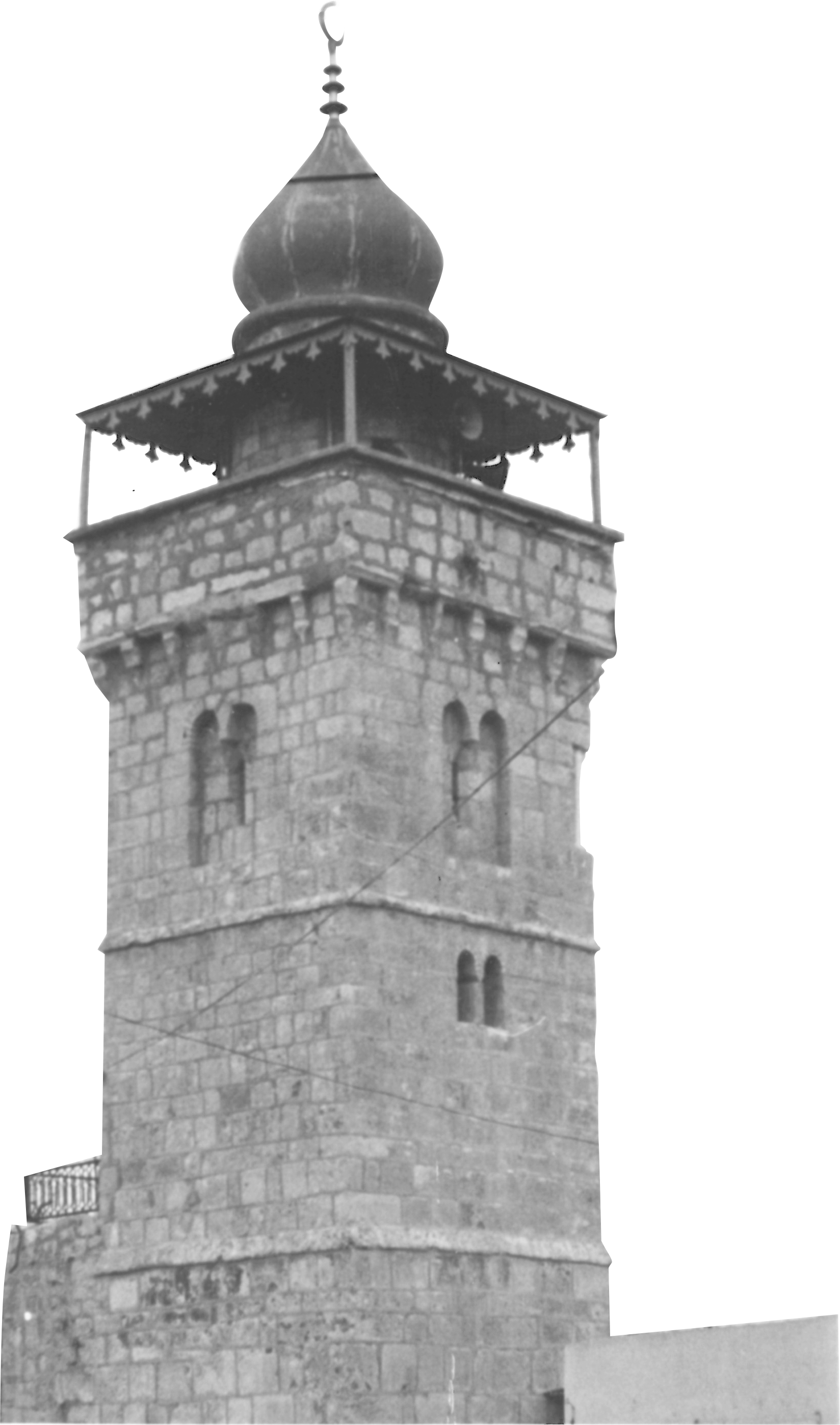
Figure (1): The upper section of the square Mamluk minaret of the Al-Khadhra Mosque
Internal description: (Figure (2))
The prayer hall of Al-Khadhra Mosque is a rectangular building extending from east to west. On its southern wall is a stone mihrab, the top of which is decorated with verses from the Holy Quran. Next to it to the west is a wooden mihrab, while on its eastern side are two large windows. On its western side is a small room with a low ceiling, approximately 2 m high. No stone column or pillar can be seen in the mosque, as it is topped by a ceiling consisting of three units of intersecting arches protruding from the ceiling. The legs of these intersecting stone arches (the crossed ones) rest on the four corners of the prayer hall.
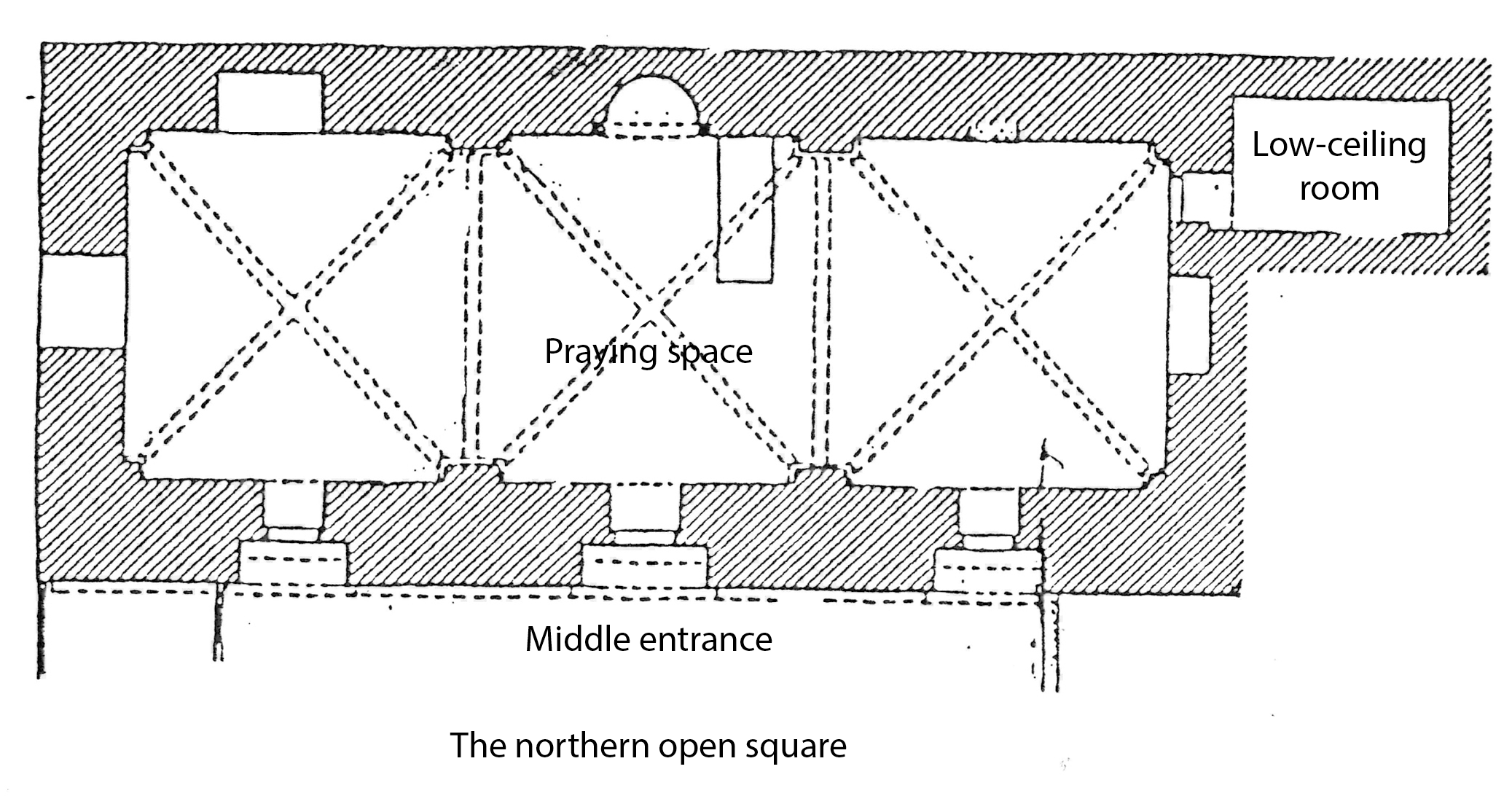
Figure (2): Plan of the prayer house of Al-Khadhra Mosque