
Yalla Falasteen
Revitalization Program
As-Salāhi al-Kabīr Mosque

As-Salāhi al-Kabīr Mosque (Visiting time is open, free entry)
As-Salāhi al-Kabīr mosque, popularly nicknamed al-Kabīr mosque, is one of the most important historic ones in Nablus. It is located at the eastern end of the old city.
It is believed that the original building of this artifice had been constructed initially as a Roman temple. The evidence for that is ascertained from the presence of a Latin inscription on the capital of a pillar there in the northern-western corner of the main hall. ''Of Lucius Lacchus”. It is the shape of the pillars at the western end where the rows comprise cylindrical columns with ornamented capitals.
It was then transformed into a Byzantine church. This is identified by the entrance at the western wall of the building. There are 14 square pillars in the eastern part of the main hall, and there is a corresponding contrast between two styles of roof construction resulting in differing ceiling heights. These indicate that the construction had been made during the later Crusader era.
As the majority of Nablus dwellers had converted to Islam, so the features of the building as a mosque had begun in consequence. At the time of Salāh ad-Dīn al-Ayyūbi, the building had been converted to a mosque. The building through its history had undergone several episodes of destruction and subsequent reconstruction or restoration. There had been at first fifty-five pillars formerly; yet, there are only 12 still standing today.
In this mosque there are several masonry inscriptions, the most important of which is what is still existing in the eastern yard. The inscription of the writing there is an Amiri decree in the beginning of Jumada al-awwal 713 AH. It emphasizes to return injustices to their owners; such as, olive oil, wheat and barley… including fairness towards Jews and Christians dwelling in the city. And this is the pledge to the non-Muslim dwellers of Nablus. Overall, it has the same degree of importance as the Umari pledge to the natives of Elia - Jerusalem - where Caliph Umar bin al- Khattab had guaranteed security to the non-Muslim natives of Jerusalem.
Historical section:
The building's proportion (identification): The proportion of this mosque was achieved by a group of architectural and decorative elements and by a group of historical inscriptions that will be discussed below in (History). The Great Salahi Mosque was mentioned in the records of the Nablus Sharia Court. In 1082 AH/1671 AD, the Turkish traveler Jalabi visited it. In 1101 AH/1689 AD, Sheikh Abdul Ghani al-Nabulsi visited it.
History: The architectural and planning fabric of the Great Salahi Mosque indicates that its construction and planning date back to the period of the Frankish occupation of the city of Nablus, specifically to the year 563 AH/1167 AD, when a Frankish church was built, known at that time as (the Church of the Resurrection). In 583 AH/1187 AD, after the Ayyubids liberated the city of Nablus from the Franks, they converted this church into a mosque, which has been known since that time until today as the Great Salah al-Din Mosque, in reference to Salah al-Din al-Ayyubi. During this time, they converted the three eastern aisles of the Frankish church into eastern entrances to the prayer house, as well as closing the western entrance leading to it and opening a wide niche in the middle of the southern wall of the prayer house. However, the presence of many architectural and decorative elements in the western section of the prayer house, especially those large stones that were prevalent in the Roman era, as well as the presence of two rows of marble and basalt columns and their Roman-style cornice capitals, lead us to believe that the origin of this western section of the prayer house goes back to a Byzantine church that existed on the site before the construction of the Frankish church. As for the eastern section of the prayer house, its layout and architectural elements indicate that it was founded during the Frankish occupation of Nablus, where two rows of stone pillars are built, some of which are fused with marble and basalt columns, extending along the same axis as the marble columns in the western section of the prayer house, in addition to noting Latin symbols and letters that are signs of the construction workers who built it, which means that the Franks expanded or annexed the Byzantine church building and integrated it into the plan of the Frankish church building. At the bottom of the building of the base of the minaret located above the northern external entrance from inside the mosque, there are three pieces of inscriptional stone that were reused in the fabric of the building (Figure (1)), which are the remains of a stone inscriptional strip written in Kufic script. These remaining stones were used in this location as reused stones without regard to their content and script. Some of its words, in which the word Allah is repeated, indicate that this stone inscriptional strip originally dates back to an Islamic religious building in this location of the city. If we take into consideration what the geographer Al-Maqdisi mentioned in the fourth century AH / tenth century AD that the Great Mosque of Nablus was located in the center of it, that is, the area where the Great Salahi Mosque is located in the middle of the old city. This is consistent with the Arab mentality of establishing and building cities or modifying existing ones so that the Great Mosque is in the center. All this leads to the possibility that the western part of the prayer house was used as a mosque before the construction of the Frankish church. The same architectural and planning elements of the Byzantine church were reused during the Islamic use of it as a mosque, which means that the Franks did not expand the construction of a Byzantine church, but rather annexed the mosque building to the Frankish church that was built next to it. Accordingly, the Ayyubids, after liberating the city in 583 AH / 1187 AD from the hands of the Franks, converted the Frankish church into a mosque according to this and according to the policy that existed between them, which was specific to converting mosques into churches and churches into mosques. During the Mamluk era, the mosque was restored and the roof of the prayer hall was rebuilt with the intersecting vaults and stone arches that prevailed in the Mamluk period. The mosque contains two inscriptions, the first of which is located inside the mosque in the open northwestern courtyard next to the small niche adjacent to the marble pool and the door of the prayer hall. It is 1.5 m long and 40 cm wide and consists of four lines in the Mamluk Naskh script. The second is located outside the mosque next to the building of the Sabil al-Kas located behind the western wall of the prayer house opposite the external ablution area of the mosque. It is made of marble, 80 cm long and 50 cm wide, and consists of six lines of writing in the Mamluk Naskh script. It is understood from the text and locations of these two inscriptions that the Great Salahi Mosque became a center for announcing and disseminating the decrees of the Mamluk authority. During the Ottoman era, the mosque was renovated and restored. This is evidenced by the important architectural additions that were made to the mosque, which include building a dome above the mihrab, restoring the square stone supports in the eastern section of the prayer house, and building the lower rooms outside the north of the prayer house, which were used as a headquarters for the mosque’s sheikh and as a corner visited by Sheikh Abdul Ghani al-Nabulsi in 1101 AH/1687 AD. It also opened the northern external entrance and built the octagonal minaret above it, and built the upper rooms that were used, before their recent demolition, as a dormitory for students of knowledge. The local script above the entrance to the marble pulpit indicates that Muhammad Jawish bin Kamal Bey built this pulpit in 1016 AH/1607 AD. A marble inscription at the eastern end of the top of the southern facade of the passage following the main eastern entrance to the mosque states that the Emir of Hajj, Minister Suleiman Pasha the Great, built two shelters in the southern part of the open eastern courtyard of the mosque in 1149 AH/1736 AD, which became known as (the Waziri Mosque) in reference to their builder, the aforementioned minister. It is also inferred from the stone inscription at the western corner of the top of the arch of the western iwan located in the west of the open northwestern courtyard that the head of the supervision in Nablus, Sheikh Muhammad Tuffaha, built this iwan in 1153 AH/1690 AD. Al-Nimr mentions that in the year 1276 AH/1859 AD, the mosque was renovated, and that during that time the octagonal marble pool was moved from its location in the eastern courtyard to its current location in the open northwestern courtyard of the mosque.

Figure (1): Remains of the Kufic stone inscription in the Great Mosque
The founder and the builders: It is not known who founded the first nucleus of the mosque in the fourth century AH/tenth century AD on the ruins of a Byzantine church and reused its architectural elements in its construction, which was discussed in the history (above), but when the Franks built a church for themselves next to it in the year 563 AH/1167 AD, they annexed the mosque building to their church. Therefore, Saladin al-Ayyubi, after liberating the city of Nablus from their hands in the year 583 AH/1187 AD, converted the aforementioned Frankish church into a mosque that has been known since that date and to this day as the Salahi Mosque, named after him. During the Mamluk era, the mosque witnessed the reconstruction of its roof, but it is not known who did it. During the Ottoman era, it also witnessed several important architectural restorations and additions, the names of some of whom were known and others were not known, including the construction of the marble pulpit, which was carried out by Muhammad Jawish bin Kamal Bey in 1016 AH/1607 AD, and the construction of the two eastern iwans (the Ministerial Mosque), which were built in 1149 AH/1736 AD by the Minister Suleiman Pasha the Great. Meanwhile, the head of the supervision, Sheikh Muhammad Taffaha, built the western iwan of the mosque. As for the rest of the restorations and additions, they were most likely carried out by charitable civil committees. Later history (modern): In 1928 AD, the Nablus Endowments Department opened (16) commercial stores in the northern outer wall of the mosque, taking advantage of the depth of the open northern square behind it from the mosque. At the same time, a side road was opened that goes up to it by a few steps from Al-Khan Street, and was cut off from the western end of the open northwestern square. At this time, a section of the Bimaristan (hospital) building located west of the mosque was converted into a special purification room for the mosque. During this time, some marble and basalt columns that were lying in the mosque square were moved to the bottom of the northern outer wall of the mosque, which was revealed by the archaeological excavations conducted in the street by the Nablus Antiquities Department in 1996 AD, due to the Nablus Municipality re-tiling the old town in this year. They were moved, four columns, by the Nablus Municipality and placed east of Nablus near the Al-Rahma Clinic. Between 1935-1936 AD, the Nablus Endowments Department rebuilt the main eastern external entrance, which had been built by the Franks in 563 AH/1167 AD as an entrance to the Frankish Church. They built it in the style of the Western Gothic entrances, but it was destroyed in the 1927 earthquake, so it was rebuilt, but in a smaller size than its previous size. In 1996 AD, the mosque was restored by a charitable civil committee with the approval of the Endowments and under the supervision of the writer of these lines. The plaster was removed from all the walls of the mosque, as well as the plastic panels that covered the square stone supports, the paint was removed from the marble and basalt columns, and the rows of stones that made up the walls were lined, which resulted in revealing the character of the ancient archaeological elements of the mosque. The Waziri Mosque (the two Iwans) was also unified and joined with the prayer house.
Architectural Description: (Figure (2))
External Description: The Great Salahi Mosque has three external stone facades. Since the mosque is located between two streets with different elevation levels, where the level of the southern Nasr Street is higher than the level of the northern Khan Street, the lower part of the southern facade is not visible, while the upper part of it is distributed with a series of windows arched with a pointed stone arch. The use of large, medium and small stones predominates in the stones of this facade, and thus dates back to the Roman, royal and Ottoman historical eras.
The northern facade extends from east to west, and it is noticeable in most of its stones the presence of large sizes that originally date back to the Roman era. A group of commercial shops were opened in it in addition to opening a small northern entrance in its middle.
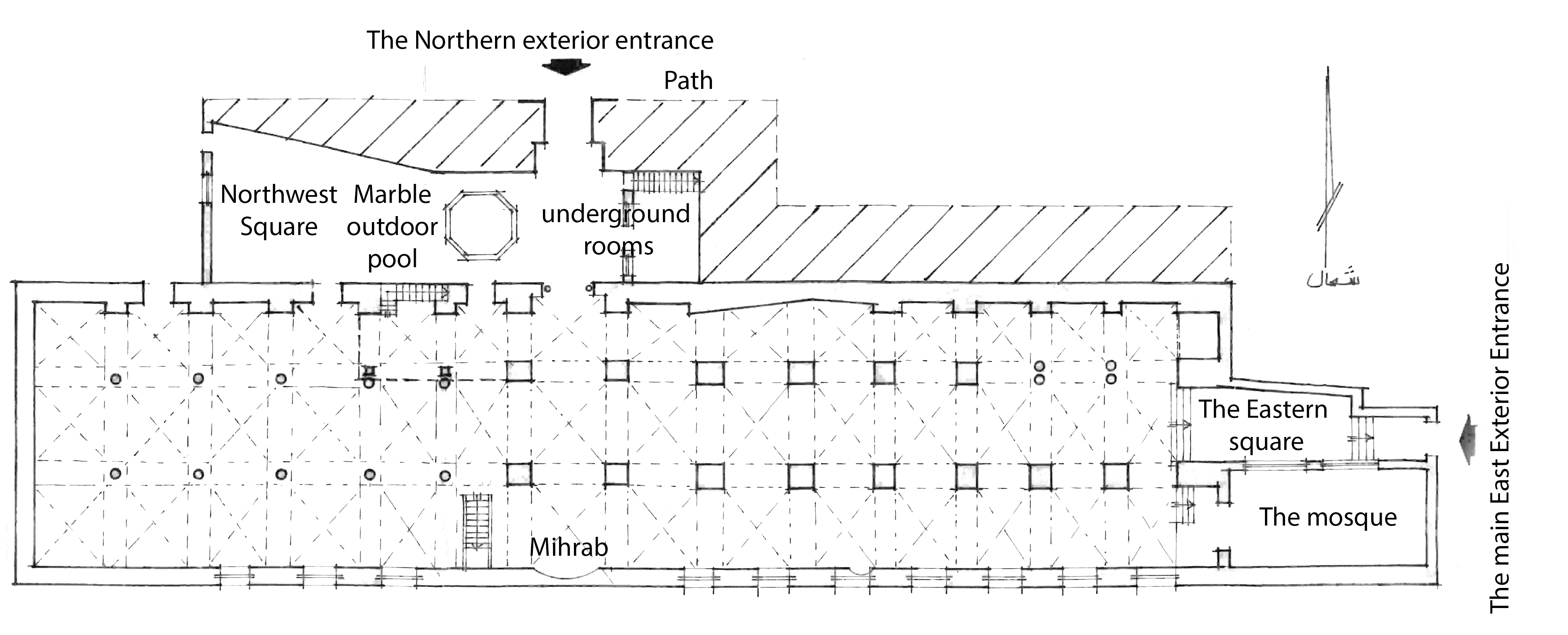
Figure (2): Plan of the Great Mosque of Al-Salahi
The western façade is distinguished by its north-south extension, not in a straight line, as the northwestern section of it is a wall approximately two meters high, in which a simple entrance has been opened leading to the open northwestern courtyard. It is a modern wall that was built after the western end of the northwestern courtyard was cut off for a side road. This wall faces the apple iwan on the western side of the road. At the southern end of this road, before it breaks to the right west, there is a small arched entrance leading directly to the prayer house, then it continues to break along the extension of the end of the northern wall of the prayer house, then turns left until the entrance located on Al-Nasr Street, where the southwestern section of this western façade is located, in the middle of which a small and simple water fountain (the cup fountain) has been opened, and next to it to the south is a Mamluk inscriptional marble inscription that has been discussed in history. At the top of this section to the south, an archway supports an entrance from the aforementioned Al-Nasr Street. The stones of this section of the western facade are characterized by being large in size and Roman in history. Also, the entrance to the Frankish church was located in this section, which was later closed after it was converted into a mosque. On the eastern side of the mosque is the main eastern entrance (Figure (3)), to which both the northern and southern external facades are connected in a curved manner. It consists of a large entrance opening topped by a straight lintel made of interlocking marble pieces (cymbals), topped by a window arched with a circular arch topped by larger circular arches whose ends rest on the stone columns that flank both sides of the northern and southern entrance opening, which are arranged with three small columns on each side. Above all of that is a large stone arch, the key of which protrudes above the level of the arch stones. It is topped by a serrated stone frieze, which is a modern reconstruction almost similar to the previous old entrance. On the northern external facade, another northern entrance was opened, which is smaller than the eastern one. The previous Roman stones were reused in its construction. It is an arched entrance consisting of an arched entrance opening with a circular arch and a height of 2 m and a width of approximately 1.50 m, and it has a deep threshold covered by a barrel vault. Above this entrance, the base of the square minaret was erected, topped by an octagonal body with small openings, and at the top of it there is an octagonal stone balcony with a small dome in the middle. The historian Al-Nimr mentions that this minaret was built by the Emir of Hajj Al-Sham Mustafa Bey Al-Faqari, who died in 1051 AH / 1630 AD, and whose grave is located on the western side of the exposed northwestern courtyard of the mosque and next to the Iwan of Apple. However, the Turkish traveler Jalabi, who visited the mosque in 1082 AH / 1671 AD, thirty years after the death of Emir Al-Faqari, recorded his description of the minaret, where he said: It stands at the entrance to the courtyard of the mosque, that is, its yard, and that it resembles a tower with a harmonious construction. This description is completely contradictory to the location and shape of the current octagonal minaret. Despite this, the aforementioned Turkish traveler did not specify which courtyard he meant at a time when there was an eastern courtyard and an open northwestern courtyard in the mosque, and two iwans were later built in the eastern one. It can be concluded from this that the entrance and courtyard described by the Turkish traveler, which had a minaret dome that looked like a harmonious tower, are none other than the main eastern entrance to the mosque, and the courtyard following it is none other than the eastern courtyard. If the external northern entrance to the mosque and the octagonal minaret above it had been present at the time of his visit to the mosque, he would have recorded their description or referred to them. This ultimately means that the attribution of the construction of this current octagonal minaret to Prince Al-Faqari is an incorrect attribution. The aforementioned minaret and northern entrance were built after the Turkish traveler visited the mosque, most likely in the first half of the twelfth century AH / eighteenth century AD.

Figure (3): The main eastern entrance to the Great Al-Salahi Mosque
Internal description: The main eastern entrance (Figure (4)) leads to a wide corridor surrounded by a northern wall, and another southern one, at the southeastern end of the top of the southern wall, there is a marble inscription. The corridor is covered by a cement roof, and at the western end of this corridor there are four stone steps.

Figure (4): A section of the open eastern courtyard of the Salahi Mosque, showing the arch of the southeastern iwan (the Waziri Mosque)
From it, one descends into a small open courtyard, to the south of which are two wide pointed stone arches resting on a square stone pillar. They precede the two iwans, which have no partition between them from the inside and are covered by two units of local intersecting vaults. They became known as the Waziri Mosque after their builder, the great minister Suleiman Pasha. At the western end of the open eastern courtyard, there is an entrance with a wide local arch. At the bottom of the entrance, there are three rectangular stone steps, from which one descends into the rectangular prayer house extending from east to west, in the middle of which are two long rows of square stone columns and pillars, which led to the formation of three porches. The two rows of columns in the western section of the prayer house are marble and basalt columns resting on stone bases, each of which is five meters high and topped by a column capital decorated with cornice-shaped decorations. In the eastern section of the prayer house, there are square stone pillars extending along the same axis as the columns, and sometimes two double columns are placed between them. In the northern wall of the prayer house, there is a group of square stone supports, smaller than the one in the middle, rising as high as the wall and ending with a protrusion at the top. They are elegantly built. There are three entrances in the northwestern section of this wall. As for the southern wall of the prayer house, there is a wide and spacious mihrab in the middle, 4 m high, 2 m wide, and 70 cm deep. It is flanked on both sides by a small stone column on which the mihrab cap rests. To the west of it is a marble pulpit. This mihrab is flanked from the east and west by a smaller and simpler mihrab. As for the top of the wall, there is a group of windows arched with a pointed arch. The prayer house is covered by a series of intersecting vaults and pointed stone arches, arranged in a way that an intersecting vault is confined between every two arches. They date back to the Mamluk era. However, during the Ottoman era, a shallow dome was opened in front of the mihrab, resting on the southern wall and on the two stone supports located in front of the mihrab to the east and west. The ceiling of the prayer house is distinguished by the fact that its western section is slightly higher than the eastern section. The northern external entrance leads to the northwestern courtyard, where in the eastern section there are two large rooms that were used as a headquarters for the mosque’s sheikh, as a corner, and now as a library. It is preceded by a large cross-vaulted roof that overlooks the rest of the open courtyard with a wide, large, and high pointed arch that rests on the top wall of the prayer house and on top of the northern external entrance, where below it and under the base of the minaret above the entrance are the remains of Kufic stone inscriptions that have been discussed in history. In the eastern corner, following the northern external entrance, there is a stone staircase that leads to the roof of the prayer house and to the eastern entrance of the minaret. Following the northern entrance is an octagonal marble pool for ablution by worshippers. Historian Al-Nimr mentions that this pool was originally located in the eastern courtyard of the mosque, but during the mosque’s renovations in 1276 AH/1859 AD, it was moved from its location in the eastern courtyard to its current location in the northwestern courtyard, the floor of which is covered with beautiful, medium-sized stone tiles. In the southern wall of this courtyard, three entrances were opened leading to the prayer house. They were arranged as follows: a large, wide entrance opposite the external northern entrance and opposite the prayer house’s mihrab. It has a straight marble lintel decorated with (24) decorative mihrab decorations. A medium-sized marble column flanks each of its eastern and western sides. A little to the west of this entrance is the second, smaller entrance, which is simple in composition and has a small circular arch. Adjacent to it to the east is a small mihrab next to which stands a Mamluk stone inscription that has been discussed in history. As for the third entrance, it is similar to the second small entrance and is currently located outside the open western courtyard, where the external side road that was cut off from it leads directly to it, which in turn leads to the prayer house.
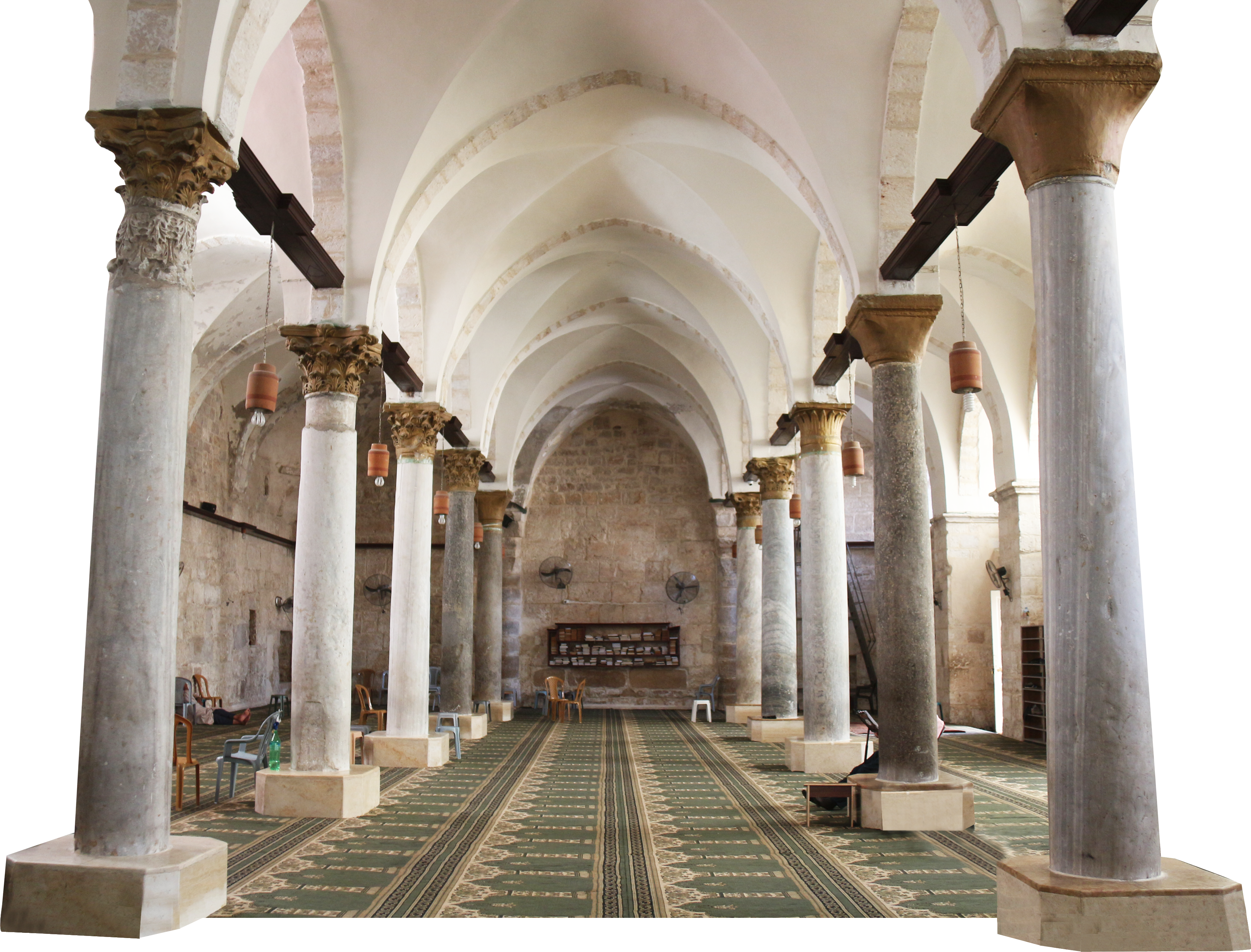
Figure (5): The western section of the prayer hall of the Great Mosque
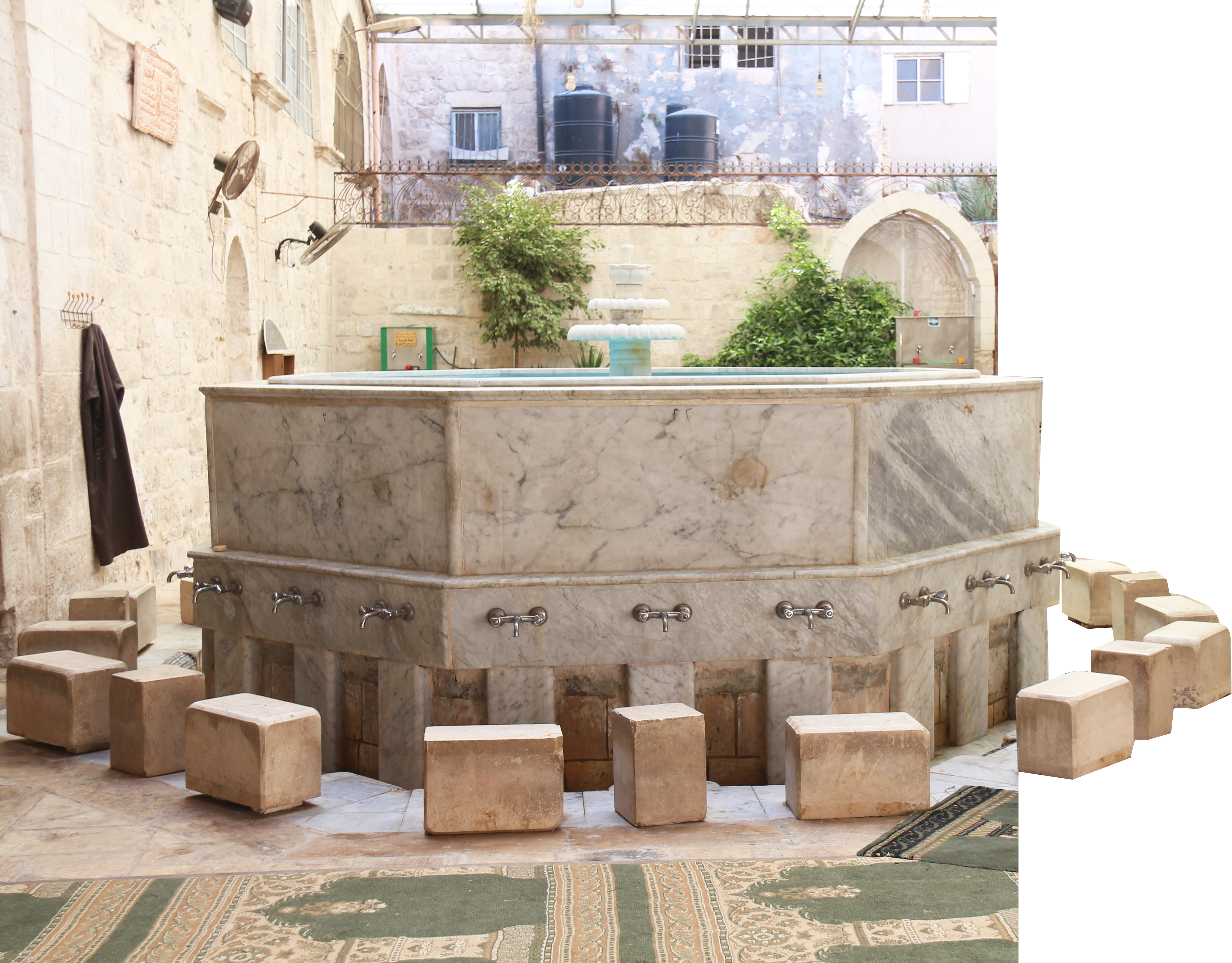
Figure (6): The octagonal marble pool in the middle of the northern courtyard of the Great Mosque