
Yalla Falasteen
Revitalization Program
The Shrine of Sheikh Badrān

The Shrine of Sheikh Badrān (External sighting from the main street)
This shrine is in the middle of the old city at an-Nasr street. The building consists of one room that has two marble columns. In the middle of the room lies the tomb of Sheikh Badrān Ibn Shibl Ibn Hāfiz an-Nabulsi. He had been a military leader from the early days of Islam and he had been martyred in Nablus in the sixth Hijri century, around 1242 AD, where he had been buried.
It is most probable that the building was originally a place for praying as well as a religious school named al-'Imadiyyah after Sheikh 'Imad ad- Dīn Ibn Sheikh Badrān who was the supervisor of the building. The site with a yard behind it had been used then as a school for about 100 students throughout the Ottoman era.
Historical section
Building attribution (identification): The building attribution was verified by two stone inscriptions, in addition to the documentation of the English surveyors in 1880 AD.
History: The building was originally a small mosque, likely dating back to the Ayyubid era. Based on the style of what remains of its roof with its intersecting vaults and pointed stone arches, it was rebuilt in the Mamluk era. The English surveyors reported when they visited the mosque in 1880 AD that the original building was a small Byzantine church, based on the presence of four Roman columns in the mosque. However, this is not conclusive evidence, because this can be considered reuse and not original, especially since the two current remaining columns of the four columns are not symmetrical or proportional in their sizes, lengths and capitals, which in turn negates that the original mosque was a Byzantine church, but rather was established as a mosque in the Ayyubid era with the reuse of these Byzantine structural elements. The first stone inscription located in the middle of the eastern wall adjacent to the grave in the mosque states that the buried there are Badran and his family (wife) and that they died and were buried in this mosque in the year 640 AH / 1240 AD. The inscription does not disclose any other details related to the owner of the grave and his relationship to the mosque, especially since the year of his death witnessed unrest in the city as a result of the Frankish invasion for two days. However, fortunately, the second inscription (Figure (1)), which dates the renovation (construction) in the year (672 AH / 1273 AD), gives Badran the title of martyr and calls him Badr al-Ghafir, which means that Sheikh Badran was martyred while resisting the Frankish invasion. The mosque witnessed renovation work during the reign of al-Zahir Baybars at the hands of Sheikh Imad al-Din, the son of the owner of the grave, Sheikh Badran. These renovation works in the year 672 AH / 1273 AD included the renovation of the shrine and the mosque, as well as the construction of a school above the mosque, which became known as the Imadiyah School in his honor. The mosque and school continued to operate during the Ottoman era. The records of the Nablus Sharia Court indicated that in the year 1066 AH/1655 AD, the judge of Jerusalem wrote to the judge of Nablus refusing to allow foreigners to reside in the Amadiyah School in Nablus, because that was contrary to the noble Sharia, and that upon the arrival of this correspondence, he should not allow anyone to reside in the school.

Figure (1): Mamluk stone inscription in the mosque and shrine of Sheikh Badran
The identity of the owner of the shrine
The internal stone inscription indicates that the name of the owner of the shrine is Badran, while the external stone inscription indicates that his name is the martyr Badr al-Ghafir and that he is the father of Sheikh Imad al-Din, the owner of the school above it.
As for the records of the Nablus Sharia Court, they mentioned him as Badr al-Din, and in another place they mentioned that Imad al-Din is the son of the martyred Sheikh Badr al-Din, while in another place they mentioned him as Badran. It is clear from all of the above that all of these names and titles, although different, are only multiple titles for one person, which is the person of the owner of the shrine located inside the mosque, as it is known that it was the custom in Islamic history for a person to be given a religious title in addition to his original name, as a form of congratulation and raising his status. Since the historical sources did not mention the name of the owner of the grave, but rather his son, Sheikh Imad al-Din Abd al-Hafiz ibn Badran ibn Shibl al-Nabulsi, who died in 698 AH/1299 AD, and whose shrine still stands on Mount Ebal and is attributed to him, this means that his father’s name, Badran, is the one mentioned in the internal stone inscription, while his title is Badr al-Din, mentioned in the records of the Nablus Sharia Court. As for the word “Ghafir” added to his abbreviated title, it means the guard and is not commonly used in Nablus, but it leads to the belief that Sheikh Badran was a guard or a guard stationed on the borders facing the Franks, and that he was a struggling sheikh. It is possible that he was also the sheikh of the mosque in which he and his wife were buried and that he was martyred during the Frankish invasion of the city of Nablus in 640 AH/1240 AD, which ultimately means that this shrine belongs to the martyred Sheikh Badr al-Din Badran bin Shibl al-Nabulsi, who died on the aforementioned date.
Founder and builders: It is not known who founded this mosque during the Ayyubid era, but it is likely that Sheikh Badran, who is buried there, founded it and became its sheikh, which is why he was buried there. The external stone inscription states that his son Sheikh Imad al-Din built it in 672 AH/1273 AD during the Mamluk era. He rebuilt its roof and added a school above it, which became known by his name.
Later modern history: It is evident from the records of the Nablus Sharia Court that the mosque was used in the late Ottoman era as an office for teaching children the Holy Quran (kuttab), while the school was used as the headquarters of the Nablus Sharia Court. However, with the earthquake of 1927 AD, the mosque and the school were severely damaged, as the school was destroyed and the mosque was ruined, which prompted the Nablus Endowments Department to demolish the damaged sections, remove the rubble and build two commercial stores. The eastern section of the mosque, which contained the shrine of Sheikh Badran, was kept, while the southern facade of this remaining part of the mosque was rebuilt. Between 1965-1967 AD, this remaining eastern section of the mosque was used as a corner until the last mentioned date, when it was closed and the place was viewed as a closed shrine, which is what it is now.
Architectural Description
External Description: What remains of the mosque, where the shrine is, overlooks Al-Nasr Street with a stone facade that is a reconstruction, 3 m high and 2.50 m wide, and consists of small, locally built building stones. At the eastern end of it is a small southern entrance with a circular arch of a local style, 1.60 m long and 1.10 m wide, its opening is closed by two modern door shutters. The western section, directly to the west of the entrance, has a window with a circular arch in the middle, 1.8 m long and 1 m wide, covered with iron bars. At the top of the facade and above the entrance, there is a window with a local circular arch, and to the west of it and above the lower window, there is a Mamluk stone inscription.
Internal description: The only southern entrance from Al-Nasr Street leads to a rectangular space extending from north to south with a length of 5 m and from east to west with a width of 2.7 m, and in the middle are two columns, the length of the northern column is 2.10 m and its circumference is 1.60 m, and it is topped with a column capital decorated with acanthus, and the circumference of its base is much smaller than the circumference of the column, which leaves a gap between the column and the capital with an upper distance of 10 cm, because here it is reused (either the column or its capital). The second column, the southern one, is smaller than the first column, with a length of 1.95 m and a circumference of 1.3 m. It is topped by a huge column capital with a base circumference of 1.30 m and a height of 90 cm. It is undecorated. In the eastern part of this area, there is a stone tomb extending from east to west of this part of the mosque. Above it, inside the eastern wall of the mosque, there is an inscription mentioning the date of the death of the owner of the tomb, which was the year 640 AH / 1240 AD, discussed in the history above. This area is covered by a roof consisting of two units of intersecting vaults between which there are pointed stone arches, the openings of which face north-south and others face east-west. They indicate the Mamluk reconstruction of the mosque, plaque (Figure (2)).
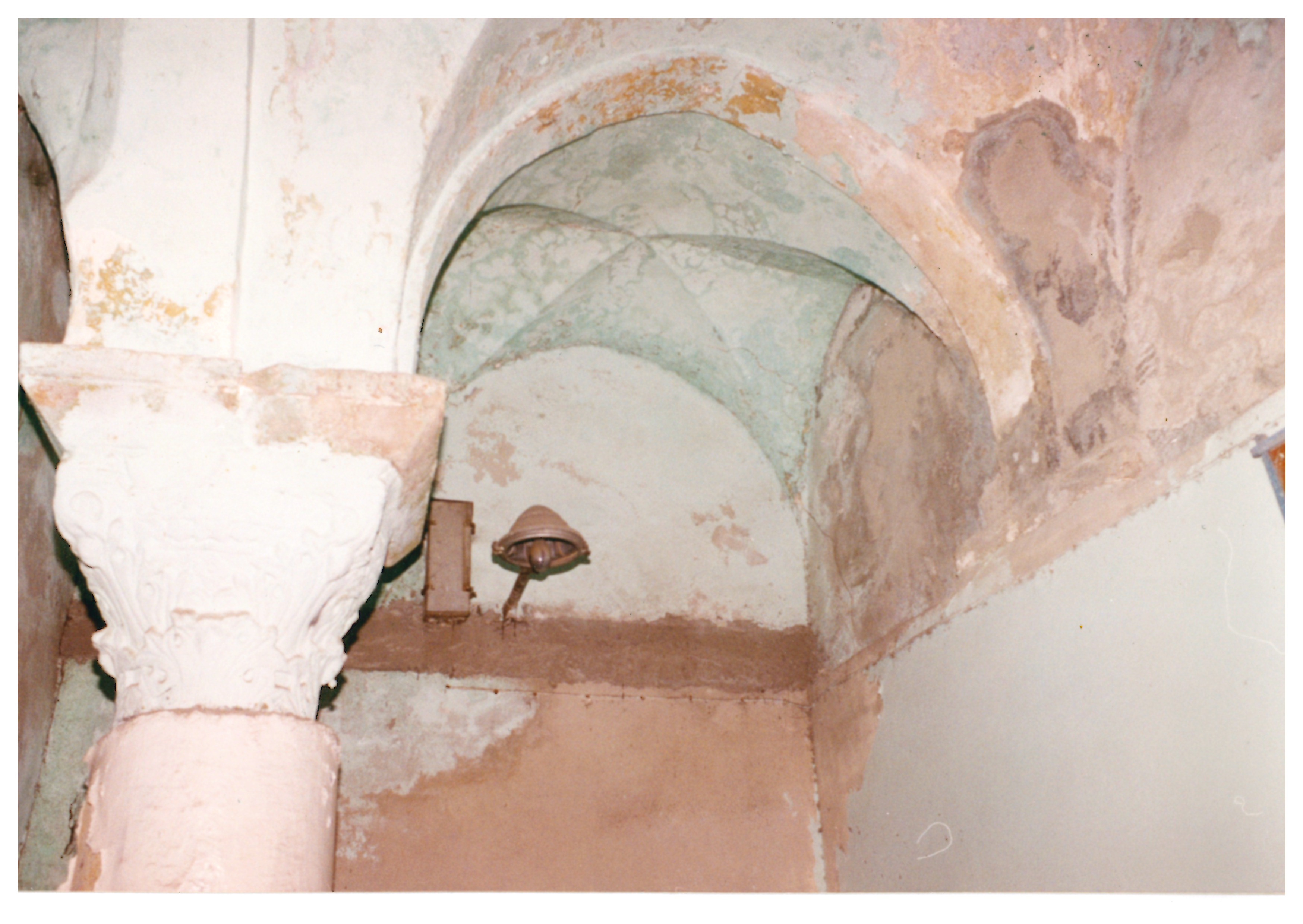
Figure (2): A section of the Mamluk ceiling where Sheikh Badran’s grave is located.