
Yalla Falasteen
Revitalization Program
The Maqam of Yūsuf (Joseph)

The Maqam of Yūsuf (Joseph) (Visiting time is open, free entry, the visiting requires a special permit from the Palestinian police at the gate).
This maqam is in the middle of the village of Balātah, to the east of the city. It consists of a square room with a mihrāb, next to an open hall (Iwān). The present features of the building indicate that it was built in the Ottoman era.
The Islamic Waqf department used to supervise the maqam during the British Mandate. Before that time, it was under the responsibility of Sheikh Fayyād Abdullah from Balātah village since 1906. He had received delegated authority via a decree from Sultān Abd al-Hamīd II. Under the Israeli occupation, the Israeli Authorities seized the maqam and changed it into a colonial outpost under the religious pretence that it was the tomb of the prophet Joseph. Yet, in spite of these atrocities, the ownership of the maqam, with its long Islamic history still stands.
Historical section
Attribution of the building (identification): It is not easy to attribute a shrine to one of the famous prophets of God such as Joseph, peace be upon him, especially since the period in which he lived is very ancient, and dates back to the era of one of the Pharaonic ruling families, but without a definitive determination. However, under the influence of the biblical narrative that states that Joseph's remains were transferred from Egypt and buried between Shechem (Tell Balata) and Jacob's Well, the search for the remains and their attribution relied on tradition and religious narrative more than on architectural or historical evidence. Perhaps the earliest attribution, although not conclusive, to the shrine can be attributed to what was mentioned in the Christian tradition in the manuscript of the list of the Holy Fathers in the year 415 AD. Where the young man Theodosius was tasked with collecting the bones of the fathers, and after excavation, a stone sarcophagus (coffin) was discovered, empty of remains, but underneath it was found a very beautiful marble sarcophagus that had not been tampered with by hands, containing a group of bones attributed to Joseph and later transferred to the Great Church of Constantine in Constantinople. The Samaritan tradition also confirms this story. Accordingly, it can be assumed that a memorial shrine was built on the site in an unspecified period of time after the discovery of the bones, mentioned by some Christian travelers and pilgrims, as Jacob's Well was mentioned later, and the shrine was indicated on the mosaic map of Madia dating back to the middle of the sixth century AD, but without any details about the site.
The shrine in Islamic sources
Muslims have been interested throughout their long history, especially in Palestine, in the heritage of the heavenly religions of Judaism and Christianity, considering Islam to be a complement to them, so they paid great attention to the shrines of the prophets and saints, visiting, building and rebuilding. This activity increased during the Mamluk era, which witnessed an urban renaissance that continued throughout the Ottoman era, including the sites of a very large group of prophets and righteous people. Among those who were included in this interest was the Prophet Joseph, as he was one of the prophets who had a great status in the Islamic faith, which prompted Muslims to take an interest in his heritage and preserve his status. The matter was not limited to the shrine and the stories narrated about it, but many customs, traditions and religious rituals were associated with it and with the people of the city of Nablus, as the shrine became a place for performing prayers, blessings, religious celebrations and fulfilling vows, which has continued for fourteen centuries and up until today.
Authenticity of the site between faith and certainty
Islamic architecture specialists have distinguished between the shrine and the grave, scene, tomb or mausoleum, considering that the former does not contain a body or remains with certainty. While the grave and its synonyms mean a burial place with certainty and evidence. On this basis, the name Maqam of the Prophet Joseph was given to the site instead of the grave of the Prophet Joseph. This is due to the fact that it is difficult to determine whether the bones of the Prophet Joseph, peace be upon him, were buried here or not.
Religious and historical sources, whether ancient, Islamic or modern, relied on the biblical narrative without conclusive evidence, and they differed among themselves significantly. One group believed that they were in this grave, another believed that they were not there, and a third group tended to believe that they were moved from this place to another place and that they were originally buried in another place. Whatever the case, the shrine of the Prophet Joseph has enjoyed a prestigious position in the heritage of the three heavenly religions in general, and has acquired an Islamic status in particular, becoming one of the famous Islamic shrines in Palestine, and a group of social and religious customs and practices have been associated with it, similar to many shrines of prophets and saints.
History: The shrine is undated and lacks evidence that supports this, but the architectural fabric of the shrine room and the dome that covers it indicate that it dates back to the architecture of the twelfth century AH/eighteenth century AD, while the construction of the tomb inside it indicates that it was built before that.
Founder and long-lived people: The founder of the shrine is unknown, unlike many Islamic shrines spread throughout Palestine, but it is registered with the Nablus Endowments Department as a public endowment that it manages, supervises, and appoints employees to serve it.
Later History (Modern): It seems that the shrine underwent some restoration in the nineteenth century AD, based on what Al-Dabbas reported, citing Father Vicor, who said that he saw an English inscription during his visit to the shrine in 1306 AH - 1888 AD, stating that the scholar Roger had been concerned with restoring the shrine building without mentioning the year of restoration.
The records of the Nablus Endowments Department state that the people of Balata village had obtained approval in 1346 AH / 1927 AD to add a room located in the northwest of the shrine and then rent it to be used as a place for teaching the village students, without this affecting the shrine’s religious and social status among the people of Nablus and Balata village, as the Islamic Endowments continued to manage it through its custodians who received their salaries from it.
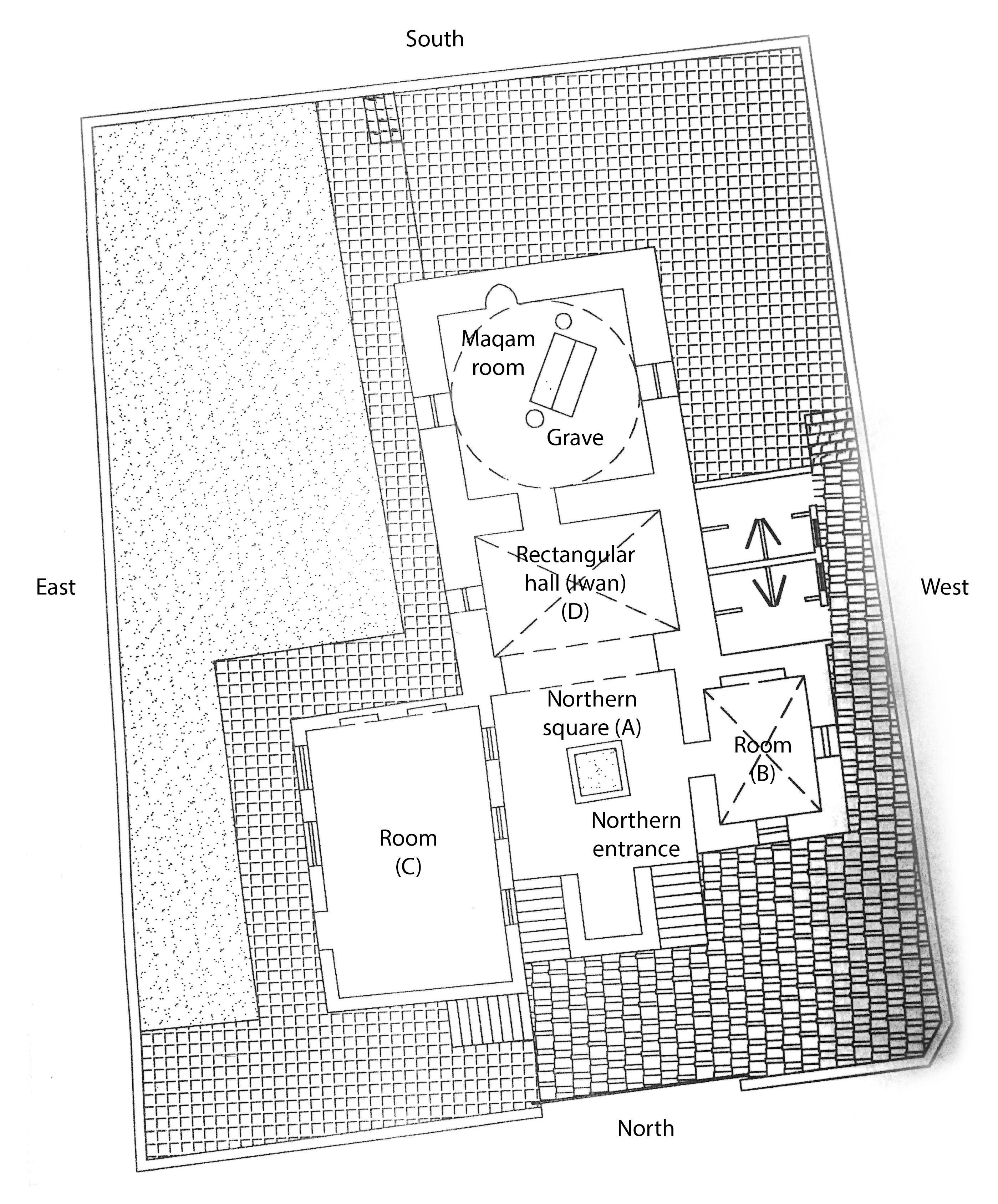
Figure (1): Plan of the shrine of Prophet Joseph
Architectural Description
External Description: An external stone wall surrounds the shrine building, its texture is made of small stones, its height is approximately two and a half meters, and it is closed on all sides except the northern side, where the shrine entrance is located.
Internal description: The simple northern door opening leads to an area at the level of the public street. At the end of this area, on both its western and eastern borders, there is a descending stone staircase preceded by a modern iron fence, so that the staircase leads to an open northern courtyard with a rectangular floor plan. The floor of the courtyard is covered with stone tiles and in the middle is a stone basin designated for agriculture. There is a room on the western side of the courtyard, as well as another room on the eastern side of the courtyard, and it is overlooked by a window and has a rectangular door. Both of these rooms are small in size and area. On the southern side is the shrine room, which is preceded by a small, simple iwan that opens onto the courtyard with a pointed stone arch. The floor of this iwan is at the same level as the floor of the open northern courtyard and is covered with stone tiles. The roof of the iwan is covered with a cross vault and a small rectangular door is opened in the wall of the southern iwan with a stone arch above it that leads to the shrine room. The shrine room has a plan that tends to be square rather than elongated. Its floor is paved with modern stone tiles and in the middle is a rectangular, gabled grave that extends from the southwestern side to the eastern side. The northern part of the tomb is preceded by a red stone column about a metre long, and in the southern wall of the shrine room there is a small niche facing the entrance to the room. A small window is opened in both the eastern and western walls of the room, while a shallow dome rests on the four walls of the shrine room, forming a ceiling for the room.
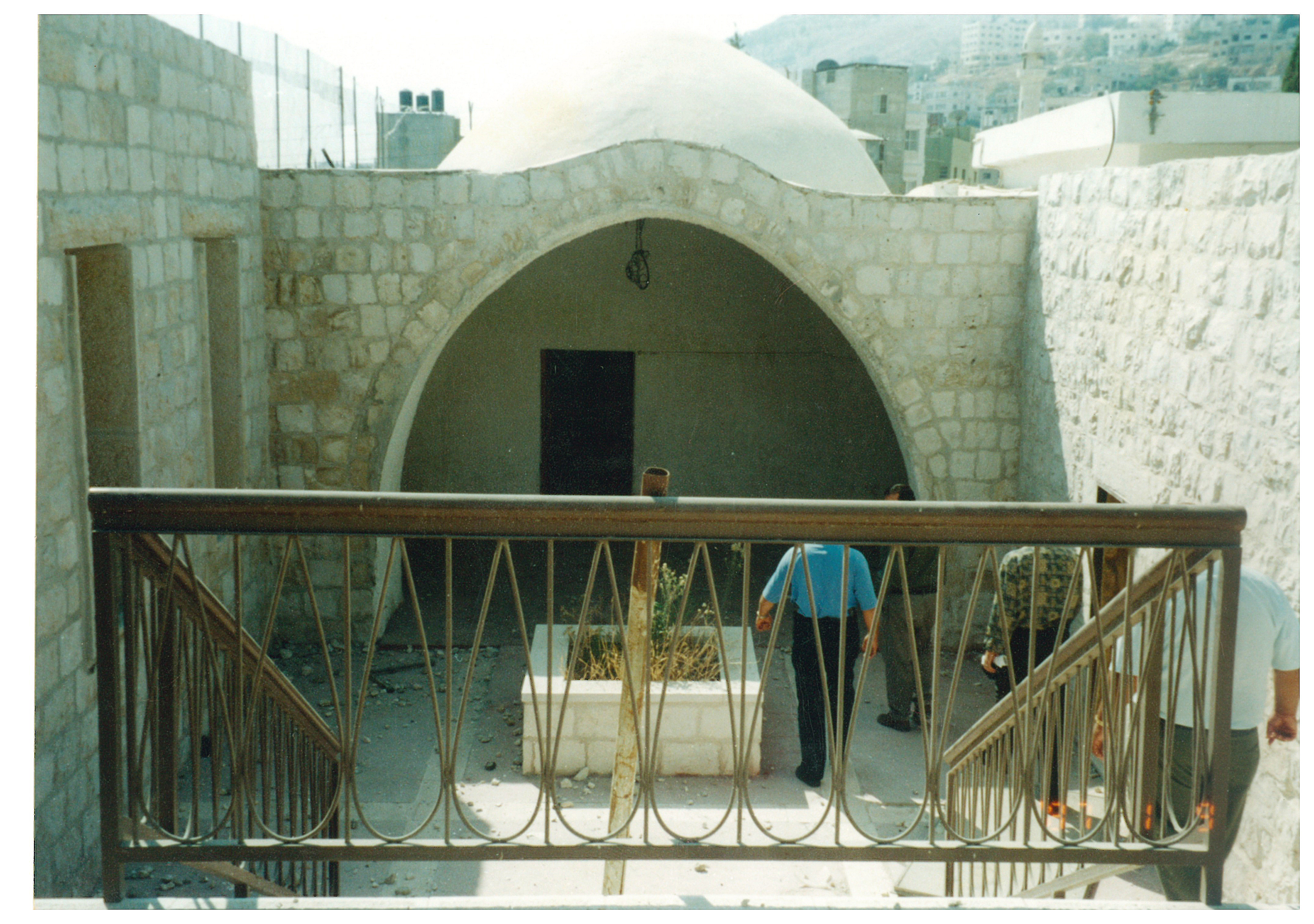
Figure (2): The open courtyard and the hall (Iwan) of the room of the shrine of the Prophet Joseph