
Yalla Falasteen
Revitalization Program
The Roman Cemeteries “Graveyards” , The Western

The Ruins of Roman Neapolis
Most of the ruins found in the Roman episode go back to the reign of emperor Hadrian 117-138 AD, and a number of them may be visited
The Roman Cemeteries “Graveyards” , The Western (Visiting time is open, free entry to the archaeological site).
Two Roman cemeteries have been found in the city; the eastern cemetery has ten graves that go back to the second century AD. These graves bear inscriptions and carvings of snakes that were believed to protect the spirits of the dead. Another western cemetery is in Haifa street. It is where stone coffins are in three caves with stone doors and beautiful ornamentation and inscriptions.
Description and history of the site
It was discovered by chance while a citizen was digging to build a house for himself in 1978 AD. The cemetery consists of a very luxurious, almost square room measuring 6 x 6 m2 covered with a dome-shaped roof, leading to it is a one-piece stone door that rotates on an axis with an iron handle. On its main facade, there are two columns on stone bases, and in front of them is a floor paved with white mosaics. This cemetery also contains ten stone coffins (ran) decorated with beautiful architectural decorations. Near one of these graves is a water well that was used to purify the dead (Figure (1))
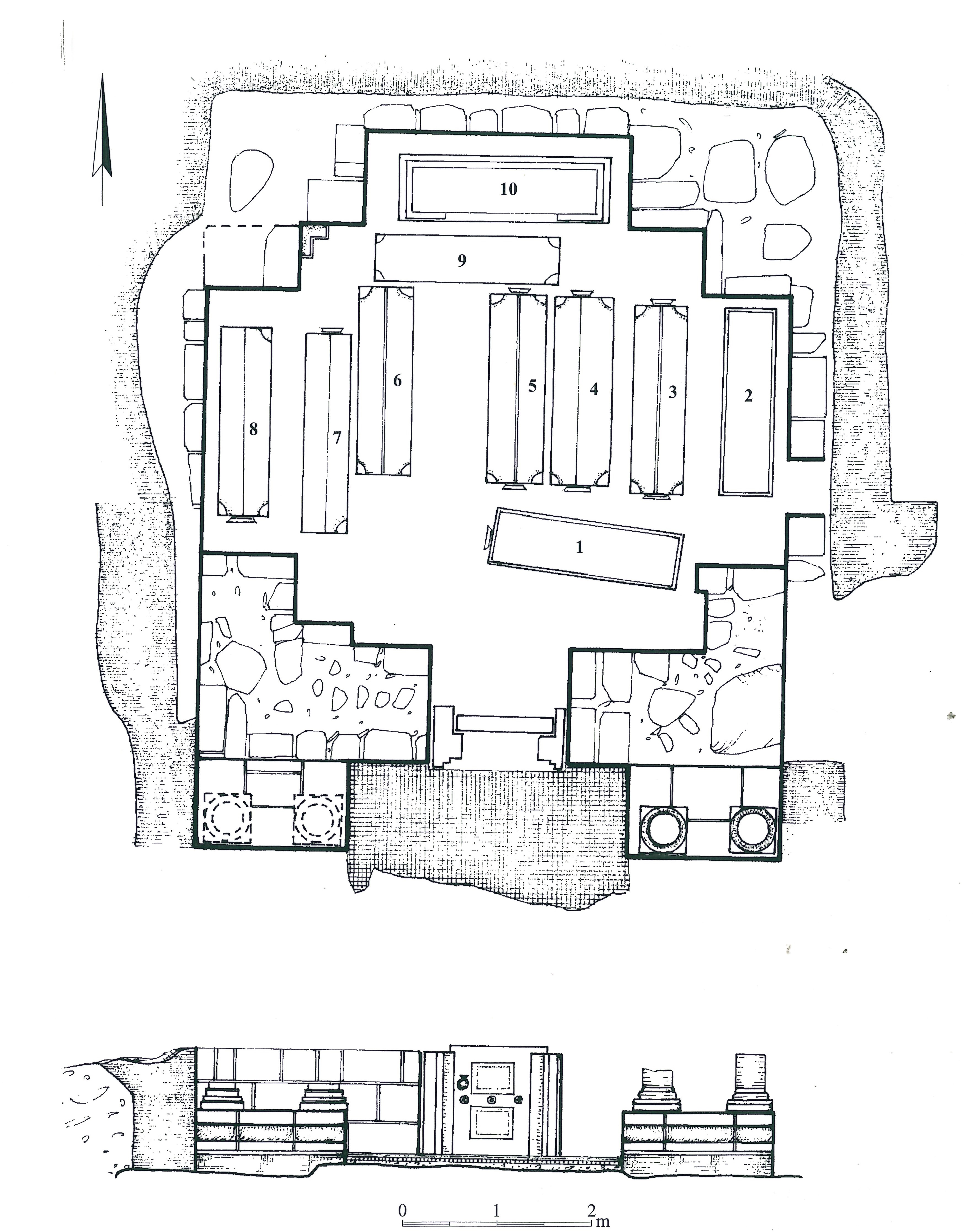
Figure (1): Plan of the Eastern Roman Cemetery - Askar Camp
Its architectural, decorative and written components suggest that it dates back to the first century AD, during which the manifestations of Hellenistic civilization continued during the Roman era (Figure (2)), as the Greek inscription on the facade of the tomb at the front of the tomb indicates that the founder of the tomb retained his original name (Greek), while other Greek inscriptions on the graves in front of and on the sides of the founder's tomb - those of the sons and grandsons - indicate that their names were changed to Roman. According to the rich architectural and decorative elements available in the tomb, and the presence of a white mosaic that is rare in tombs except during the era of the Roman city of Neapolis, it is believed that this tomb belongs to one of its wealthy families. It is inferred from the pottery discovered in it dating back to the second and third centuries AD that it was used again during this period of its history in the Roman era.
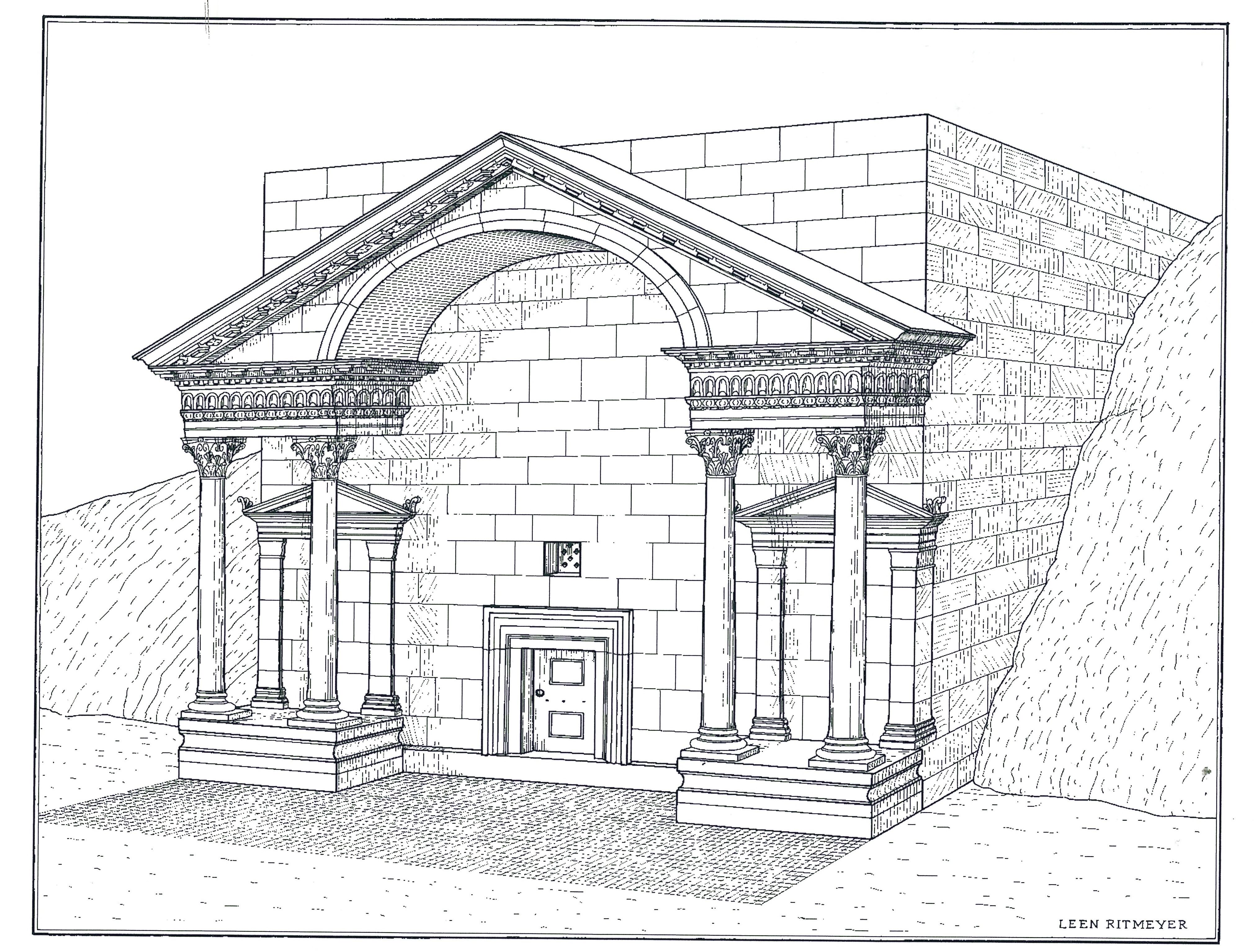
Figure (2): A common depiction of the Eastern Roman cemetery as it was in the first century AD - Askar Camp