
Yalla Falasteen
Revitalization Program
Temple of Jupiter

The Ruins of Roman Neapolis
Most of the ruins found in the Roman period go back to the reign of emperor Hadrian 117-138 AD, and a number of them may be visited.
Temple of Jupiter (Entry is forbidden to the archaeological site).
Traces of a temple can be seen on this site. It is located on top of al-Ras hill on the southern mountain, app. 840 m. above sea level. Israeli forces built a military base around it. And so, visitors can only see the site from the site of the Virgin Mary church in the opposite direction. It is not allowed to be on the site.
History of Excavations
In 1866, Wilson wrote a brief description of the remains of an existing building at Tell al-Ras, stating: “There is an artificial plateau, isolated by a deep trench, and there is a trace of a staircase leading to the top of the plateau, where the building has thick walls.” Some excavations were carried out, but nothing of interest was found except for some coins dating back to the Roman era. In 1930, a German archaeological mission headed by Schneider surveyed the temple area and carried out some excavation work in the center of the mountaintop, where he noticed walls related to the remains of Roman buildings, and thus believed that they belonged to the famous Roman Temple of Jupiter. In 1935, Ben Zvi uncovered a section of the staircase that led to the top of the mountain where the temple was located. In 1962, the American archaeological mission working in Tell Balata conducted a complete survey of the Tell el-Ras area, where it discovered the remains of granite columns that were spread on the northern side of Mount Gerizim. In order to find out the reasons for the presence of these columns, which were in large numbers and of a high level of technical craftsmanship, it was decided to conduct archaeological excavations at the site between 1964 and 1968 AD under the supervision of Bull, who, in addition to studying these columns, studied the Roman coins discovered at the site and concluded from analyzing the writings and inscriptions that they were minted during the reign of Emperor Antoninus Pius (138-161 AD) and during the reign of Emperor Elagabalus 222-208 AD (Group (1)), and that on the back of the coins was engraved a mountain with two peaks and on top of each of them a building, one of which is larger and located on the left, and architectural details were given on it with a staircase descending to the bottom of the mountain and meeting with the street of columns of the city of Annapolis, which led Bull to assume that a temple in the Greek style was located here in Tell el-Ras. In 1986, Magen excavated around the stairs leading to the mountain and discovered a small pagan religious building west of the stairs dating back to the first century BC.
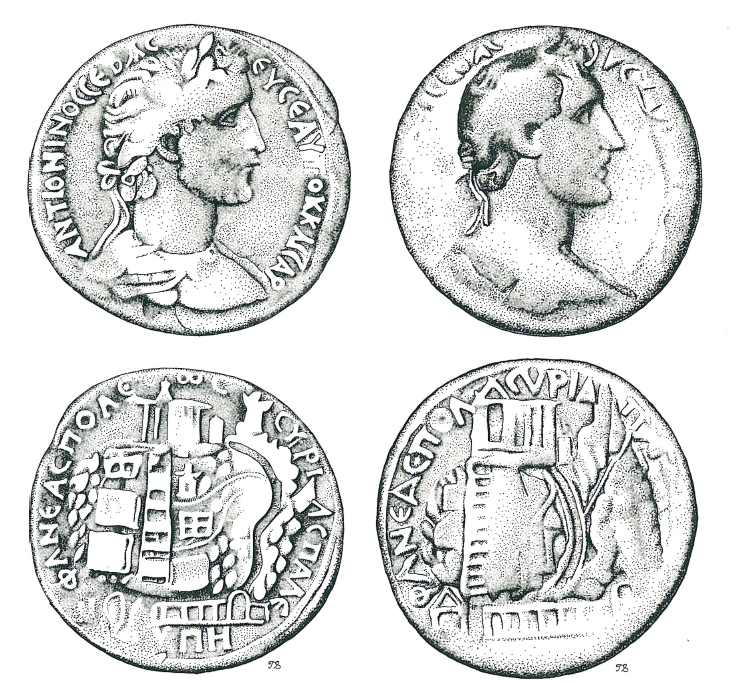
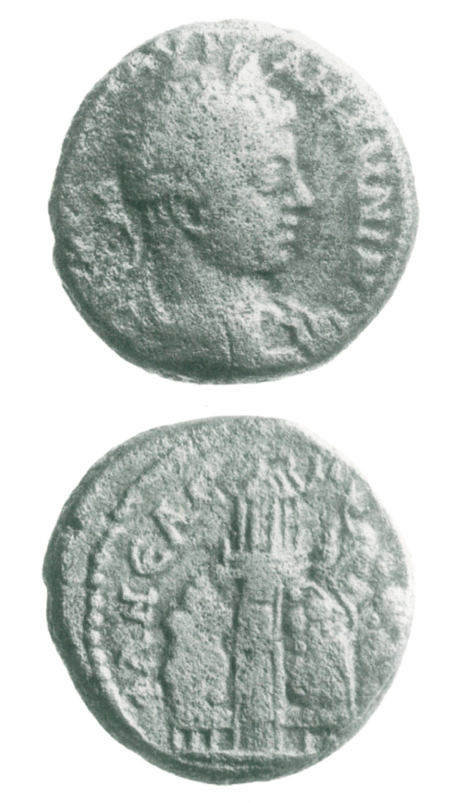
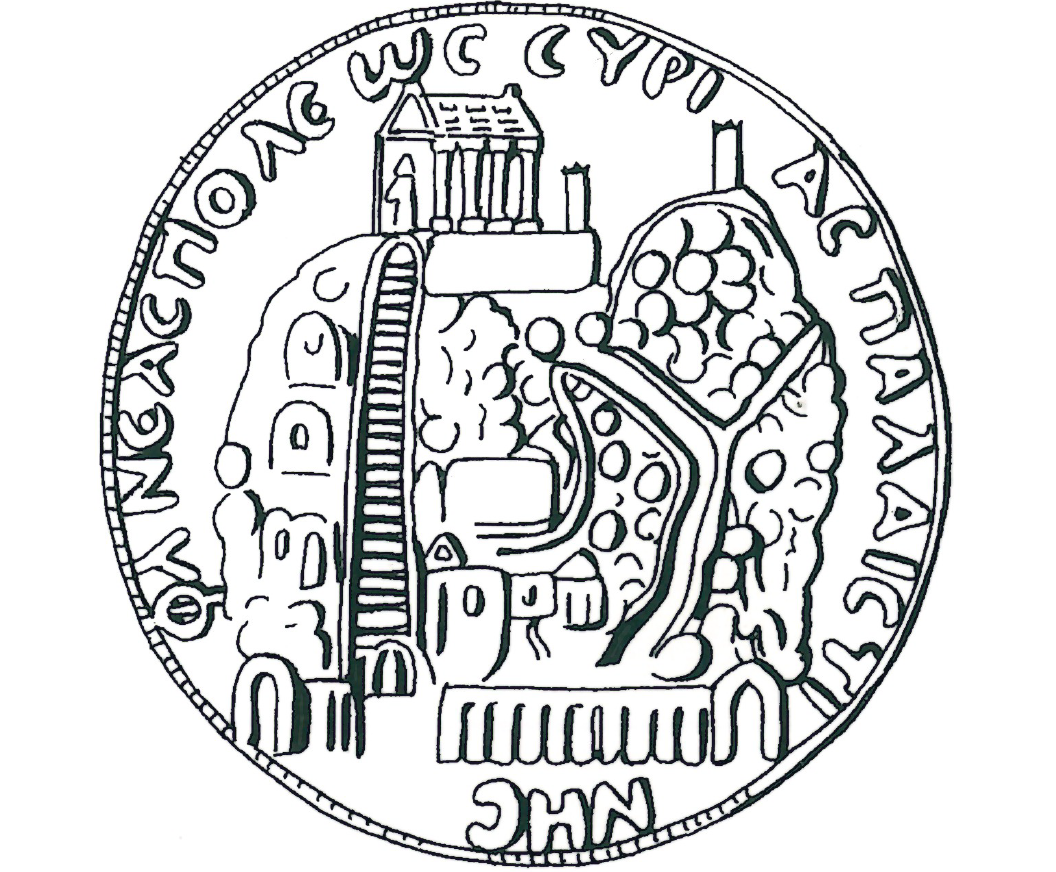
Group (1): Coins of Antoninus Pius, lower section, coins of Gabalius, with a depiction of the temple, the stairs, and the two mountain peaks
Results of archaeological excavations and description of the temple: Bull, the supervisor of the excavation works, classified his architectural and archaeological discoveries into two sections. He called the first of them Building (Temple) A, in which it became clear that the temple is a large square that does not include internal buildings, and that it was built on a stone platform for the purpose of raising it, which required digging trenches and walls 2 m wide. Its lengths from north to south reached 64 m and its width from east to west was 44 m. The walls of the platform were filled with stones and rubble. There is a group of rooms and stone buildings in different places west of the temple, built in the form of vaults connected to each other and to those located north of the southern wall of the temple area (Figure (1)), in addition to finding pieces of pottery and ceramics, and remains of three steps.
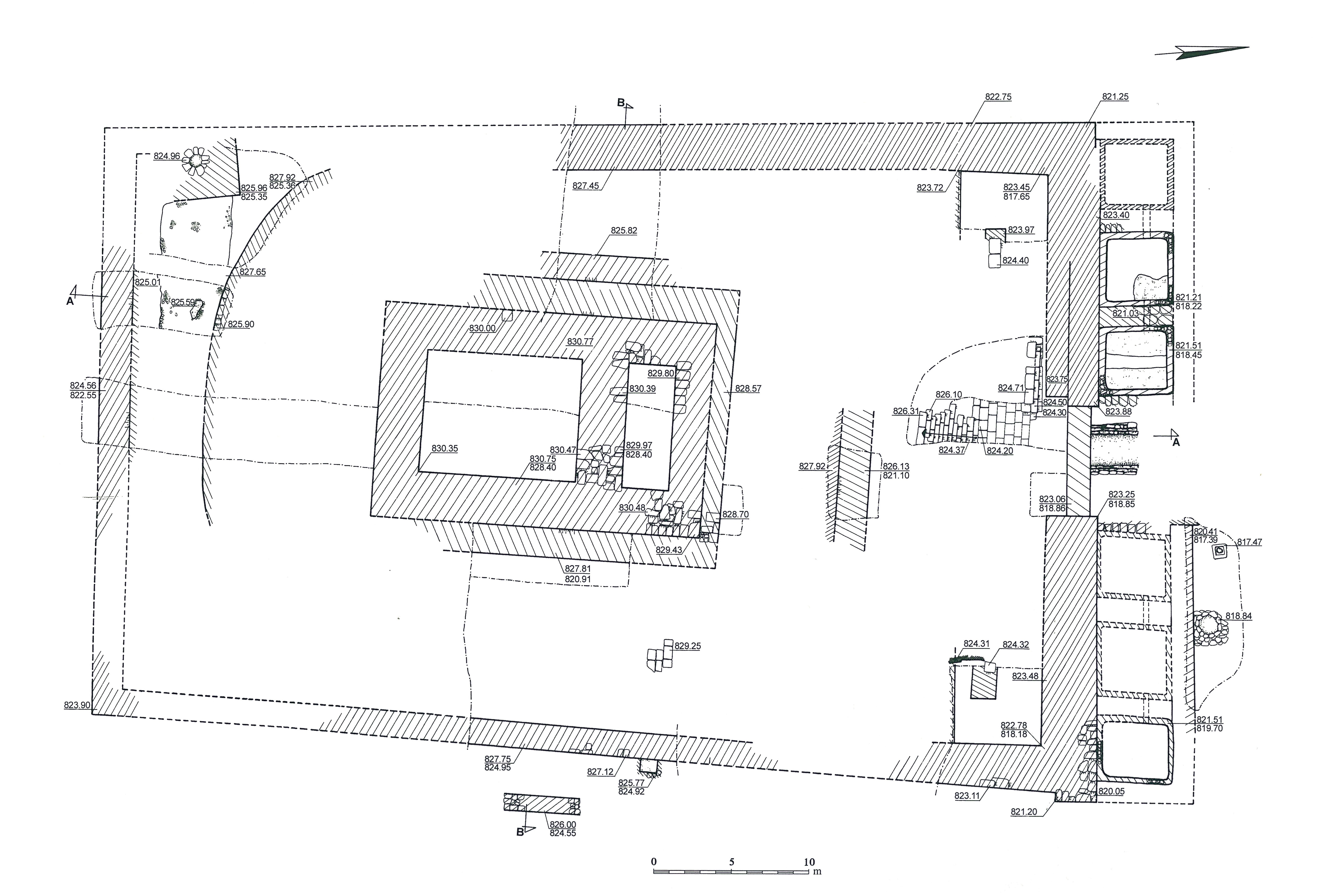
Figure (1): Units and architectural elements in Jupiter
The second section is section B, which is located below section A. It was found that section B consists of walls that form the basis of Temple A above it, and they are 32 m wide, and above them is the platform on which the temple stands. A Roman wall built on rock was discovered, as well as ceramics and pottery dating back to the Hellenistic era, which is the date in which the walls were built around building B. Bull concluded that this temple was built in 130 AD by Emperor Hadrian (117-138 AD). This is confirmed by the discovered coins as well as other historical sources. This temple was built or merged with the lower building B, which dates back to the Hellenistic era, as it was a Hellenistic temple for the Greek god Zeus. (Figure (2)) Excavations revealed ponds to collect rainwater, which were located east and west of the temple, and they were enclosed and date back to the third century AD.
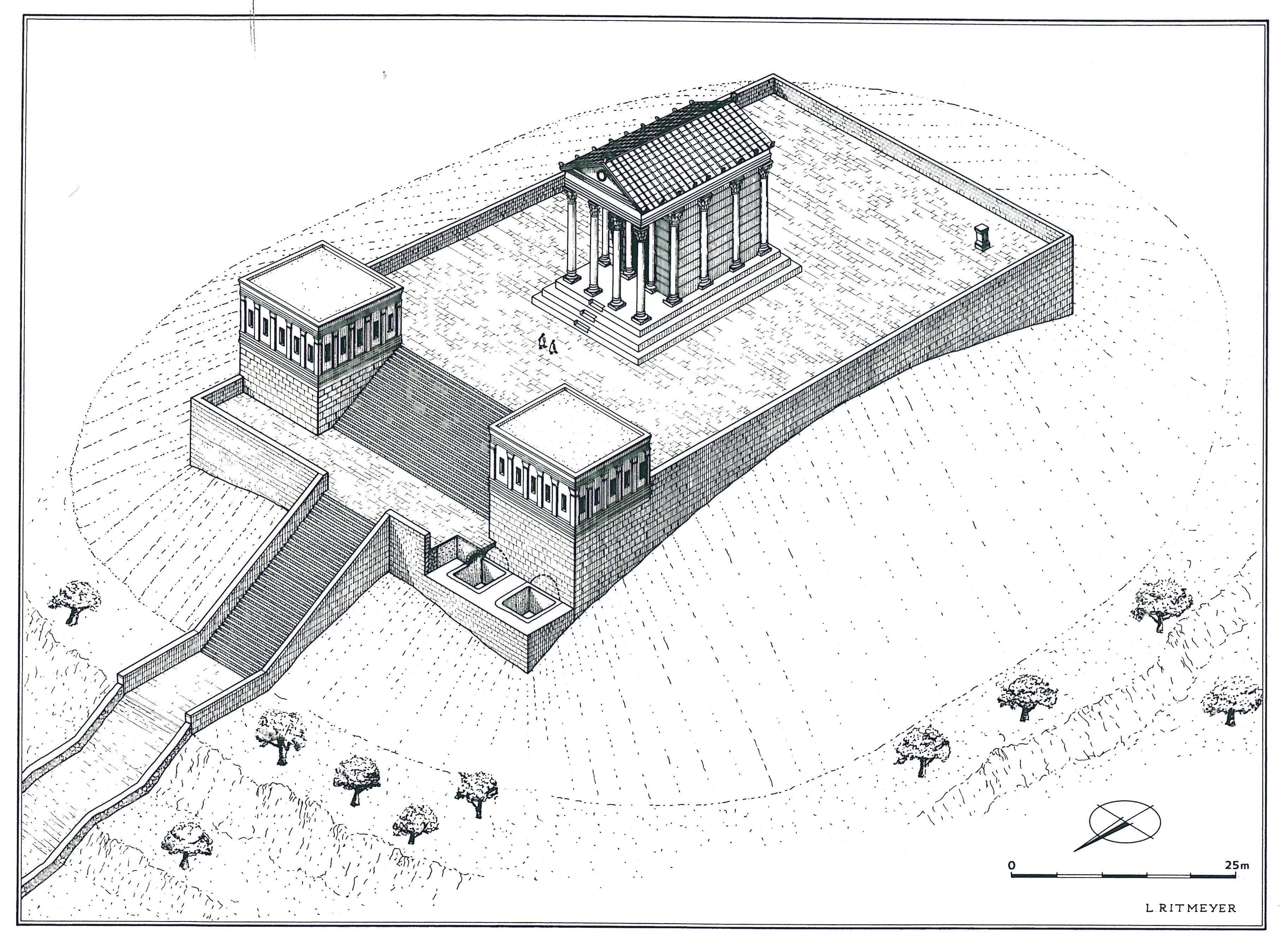
Figure (2): Re-imagining the plan of the Temple of Jupiter in the third century AD
As for the stone staircase leading to the temple from the bottom of the mountain, the remains of 65 steps were discovered, carved in a single line in the heart of the mountain. It was found that the staircase begins from the west, where the current column is located at the bottom of the mountain. This staircase consists of 1,500 stone steps, not 300 steps as the pilgrim of Bordeaux mentioned in the year 333, and it remained in use until the Byzantine era.