
Yalla Falasteen
Revitalization Program
The House of Al-Bayk Tūqān

The Tūqān house is the largest of all the houses in the old city of Nablus. It had been built with an area of about five dunums including the garden. It has vaults, arches, broad yards, gardens, water fountains, and upper storeys. The Tūqān family came to Nablus in the early years of the 17th century. They had great power in the region, and the head of the family, Ibrāhīm Pāsha Tūqān (d.1795 AD) was the one who built this house. The main entrance courtyard is reached through a large entrance gate from the main street that carried the family name. The house consists of three residential compounds, each with an open yard in the centre, built on several levels above that of the main street. The entrance-way leads to a wide passage of stone seats for the guards to sit on. There is also a room for them to rest close to the entrance next to the passage, and the stables for horses are on the two sides of this passage. A stairway in the front part leads to the upper rooms. There is also a lush garden of fruit trees at the south eastern end of the house.
Historical Section
The building's proportion: The building's proportion was confirmed by its architectural fabric, its construction plan, its large size, and what the historian Al-Nimr mentioned.
History: Al-Nimr recorded that Sheikh Ibrahim Bey Ibn Saleh Pasha Touqan, who died in 1201 AH/1786 AD, built this palace after his father Saleh Pasha provided him with the necessary funds. Al-Nimr added that the palace witnessed many events, seditions, and political conflicts that took place between the princes of the Touqan family and other local princes. The architectural fabric of the palace belongs to and is similar to most other palaces in the city, such as Al-Nimr Palace, which makes the palace date back to the first half of the twelfth century AH/eighteenth century AD.
Founder and builders: The palace was built in the first half of the twelfth century AH/eighteenth century AD by Sheikh Ibrahim Bey Ibn Saleh Pasha Touqan, the head of the scholars of Nablus at that time.
Later history (modern): The palace continued to be a residence for the Beykat branch of the Al-Touqan family and their descendants until today, despite the decline of their political influence and the change in circumstances, as a family from the Al-Touqan family still lives there today, although it has become neglected, cracked and dilapidated. The palace cracked and part of it was demolished, and in 2006 some neighborhood committees helped to repair it, but during its cleaning, the historical character of the palace pool was distorted.
Architectural description (Figure (1))
The palace consists of two floors, which are led by two western entrances, and can be technically divided into a northern section and a southern section:
The northern section: It is reached from the western public road, where stone steps lead to a small entrance (2 m long and 1 m wide) topped by a stone arch. The entrance leads to the second floor of the palace, where the northern section is located, in the middle of which is a large open northwestern courtyard paved with stone tiles and in the middle of which is a rectangular pool of water (Figure (2)) measuring four meters long, three meters wide, and 7 cm high above the ground of the courtyard. In addition to the entrance, there is a medium-sized room on the western side of the courtyard, and on the southwestern side of it there is a stone staircase leading to the upper rooms and also leading to an open corridor leading to the southeastern section of the palace. In the northeastern corner of the courtyard there is a small, arched entrance leading to the eastern section of this northern section of the second floor of the palace, in the middle of which is another large open courtyard overlooked by a large Iwan and rooms on its southern side. On the eastern side of this eastern section there is a dilapidated stone staircase leading to the top.
The southern section: It is reached from the western public road of the palace, where the large, well-built palace gate stands, which is located inside a niche (arch) set back from the level of the facade (3.5 m high and 2.5 m wide), topped by a pointed arch, and on each side of it is a small stone niche, and, and, and, and opening in this beautiful gate, a stone entrance ends with a motorized arch, its cymbals are decorated with circular geometric decorations, and rows of stones are arranged above the entrance until they are surrounded by a pointed arch, inside the niche (Figure (3)). The entrance leads to a corridor covered with a cross vault leading east to an open courtyard where the first floor of the southern section of the palace is located, where there are two rooms south of the courtyard, and to the north of it is the palace stable, and to the east of it a stone staircase was built leading to an open north-south corridor, where at its northern end is a small entrance leading to the second floor of the northern section of the palace. Meanwhile, to the south of the courtyard is another small entrance leading to the second floor of the southern section of the palace where the garden and a group of rooms extend south where Al-Nabulsi’s house is located. Its western outer wall features longitudinal openings (mazaghal), which contributed to fortifying the palace. The rooms of this section extend westward to above the arch that stands above the southern gate of the western main road.
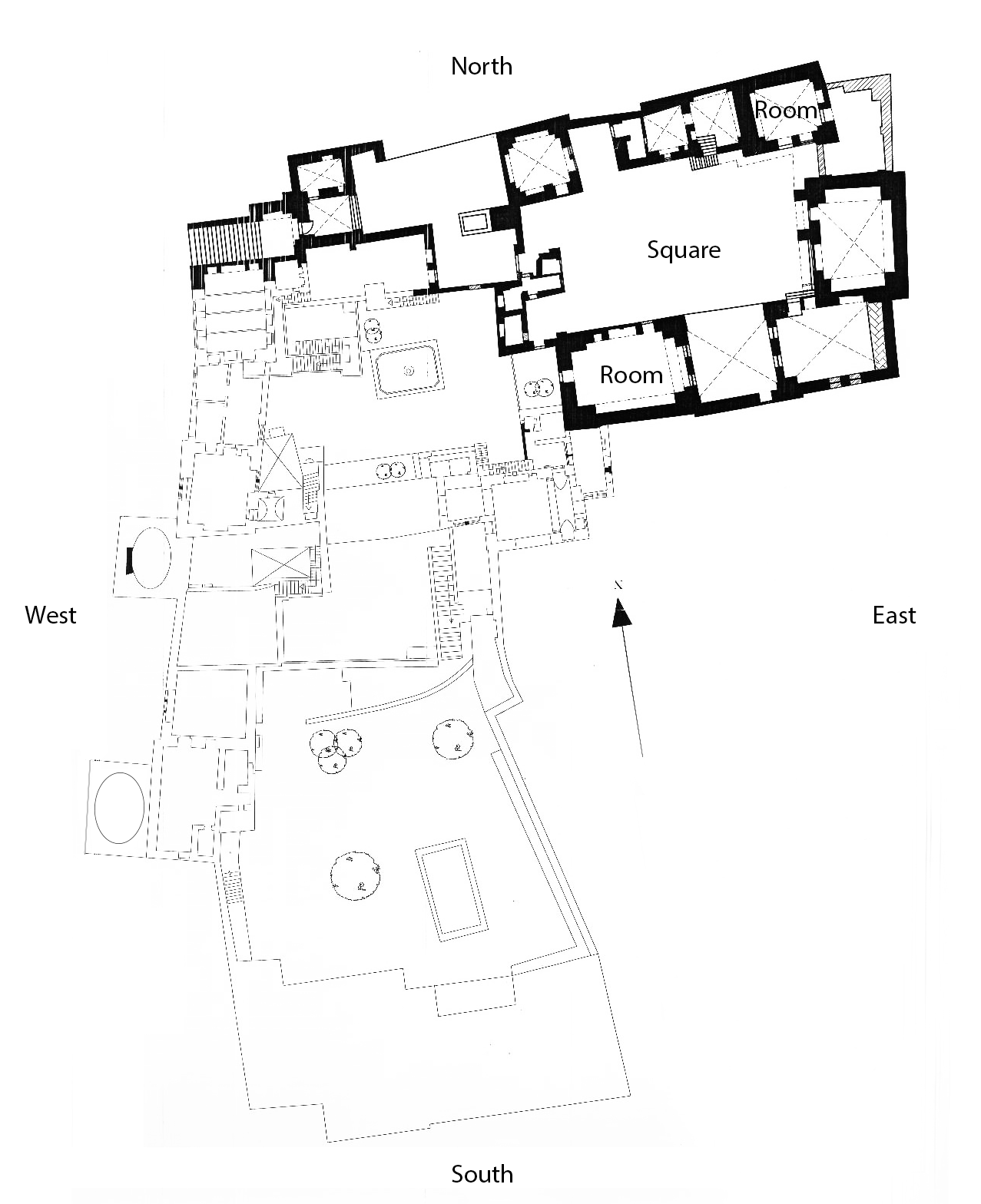
Figure (1): The first floor of Touqan Palace
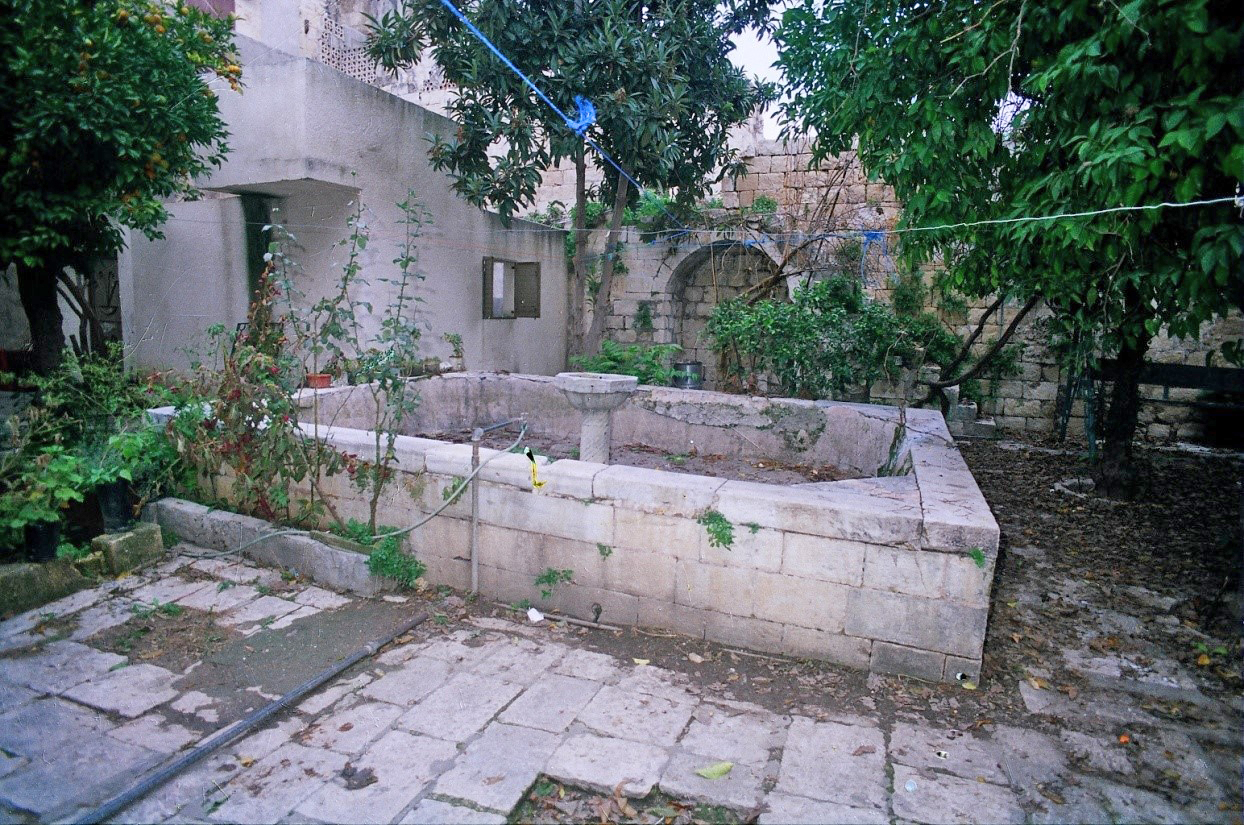
Figure (2): The pool in the open northern courtyard of the second floor of Touqan Palace

Figure (3): The main western gate of Bey Touqan Palace