
Yalla Falasteen
Revitalization Program
Al-Jadīdah “ash-Shefā'” Bath

Al-Jadīdah “ash-Shefā'” Bath (Men’s days: Saturday, Monday, Wednesday, Friday. Time: 09:00 – 24:00. Women’s days: Sunday, Tuesday, Thursday. Fees: NIS 40. Tel: 09-2381176)
Al-Jadīdah bath or ash-Shefa or ash-Shifa, is at an-Nasr Street in the middle of the old city.
This bath has been the latest to be built in 1736 AD. The summer dressing room is unusually large in comparison with similar ones.
The bath is owned by the Tūqān family. The inscription lauds the city’s rulers and refers to contemporary events:
When God decreed that felicity be completed
He inspired with Concorde the brothers of faithfulness
These are Salah, Ahmad, and Mustafa
The sons of Ibrāhīm, the most worthy successors
From the family of Tūqan, who are famous for generosity
Elegance, bounty, perfection and fidelity;
They built the Na'ĩm and Shifā’ bath
Which is so attractive in its decoration,
In determining the date of its establishing I say:
"May pleasure always accompany them in the Shifā’ bath"
Historical Section
The building’s proportion: The building’s proportion was confirmed by a stone inscription, and by what the records of the Nablus Sharia Court mentioned about it.
History: The stone inscription above the small northern entrance states that the bath was built in 1135 AH/1732 AD and that it was built by the three brothers Saleh, Ahmed and Mustafa and the sons of Ibrahim Touqan. The records of the Nablus Sharia Court state that Ahmed Agha, son of Ibrahim Touqan, endowed his share of the bath, amounting to eight carats out of twenty-four carats, as a family endowment in 1138 AH/1725 AD. It also stated that his brother, Hajj Saleh Pasha Touqan, the former governor of Jerusalem, also endowed his share of the bath, amounting to eight carats out of twenty-four carats, as a family endowment in 1141 AH/1728 AD.
The founder and the residents: This bath was founded by the three brothers Saleh, Ahmed and Mustafa, the sons of Ibrahim Touqan.
Later history (modern): The bath temporarily stopped functioning in 1990 AD and was restored and then re-operated in 1997, but unfortunately it was partially destroyed in the roof of the heat house during the Israeli invasion of Nablus in 2002, and it was reconstructed and operated in 2004 until now.
Architectural description
The bath is reached from Al-Nasr Street, through a long alley heading north-south opposite Al-Bayk Mosque, and is ascended by stone steps to the northern entrance of the bath. It is a small entrance (2m by 1m) topped by a semi-circular stone arch above which is a stone inscription (Figure (1)). The entrance leads to a corridor that breaks to the right and then to a small hall used as a stable for the bath. At the western end of this corridor, there is a reception hall with a stone tile floor, and in the middle of it is a polygonal pool of water. Its four sides are occupied by raised stone benches for bathers to sit on, while its roof is formed of a large shallow dome, in the center of which is an opening to let in air and light. The dome rests on four stone arches. In the southeastern corner of this hall, there is a stone staircase leading to the residency and the roof of the bath. The winter mashlah room is reached through a small entrance at the end of the eastern wall of the reception hall, which leads to a small corridor that leads to another large corridor that is perpendicular to it and at the end of which is a bench for bathers to sit on. The bathing room is reached through a small corridor that ends with an entrance topped by a semicircular arch. The rooms are rectangular in shape, with a group of rooms and cells on their northern and southern sides, each with a stone basin to contain water. In the middle of the eastern wall of this hall, there is a small square opening that overlooks the places where the water is heated. The bathing hall is covered by a vaulted style with moon-shaped windows covered with colored glass (Figure (2)), and its floor was covered with beautiful old stone tiles, but it was replaced with modern tiles during the recent renovations of the bath.
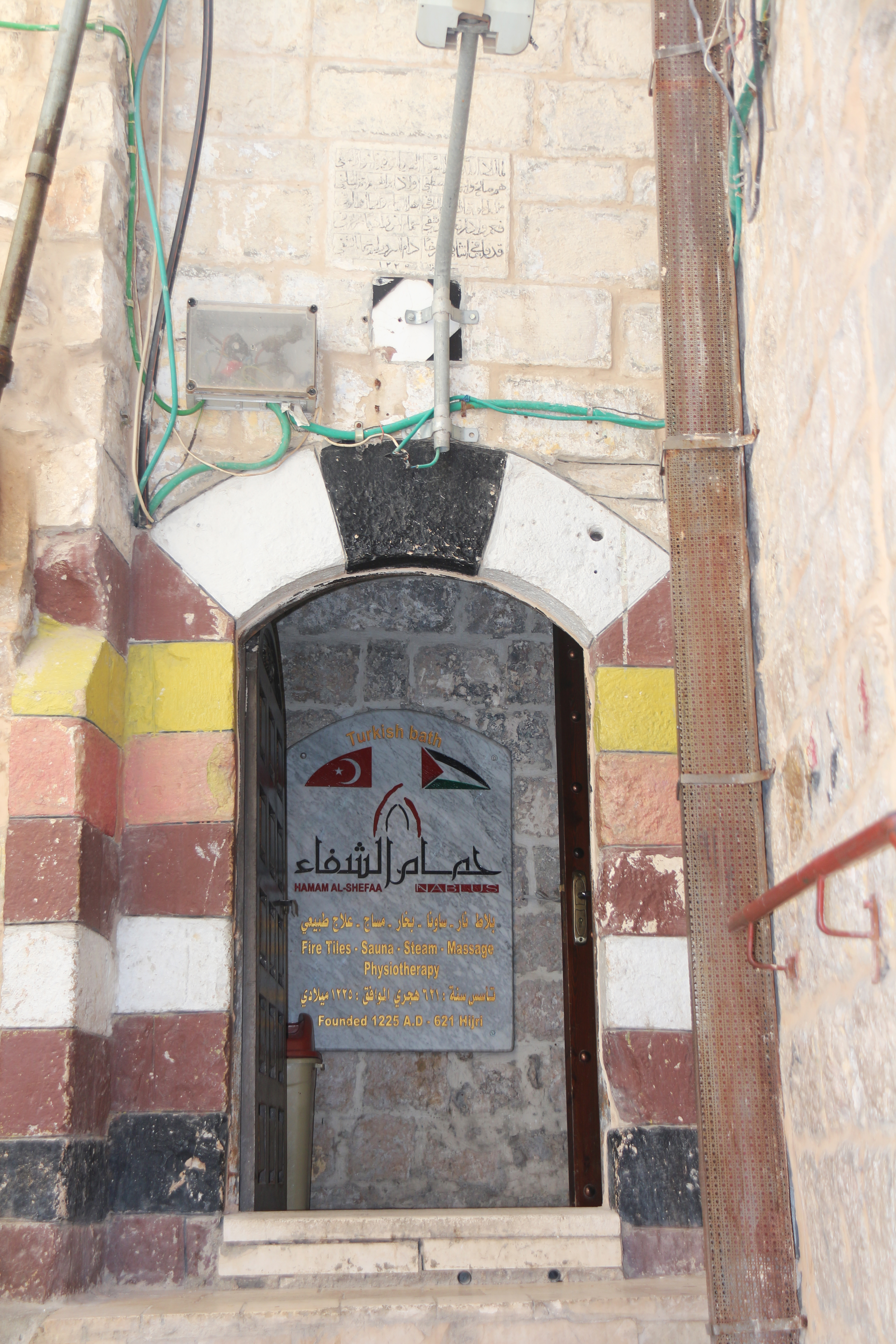
Figure (1): The northern entrance to the Al-Shifa Bath (Al-Jadidah)
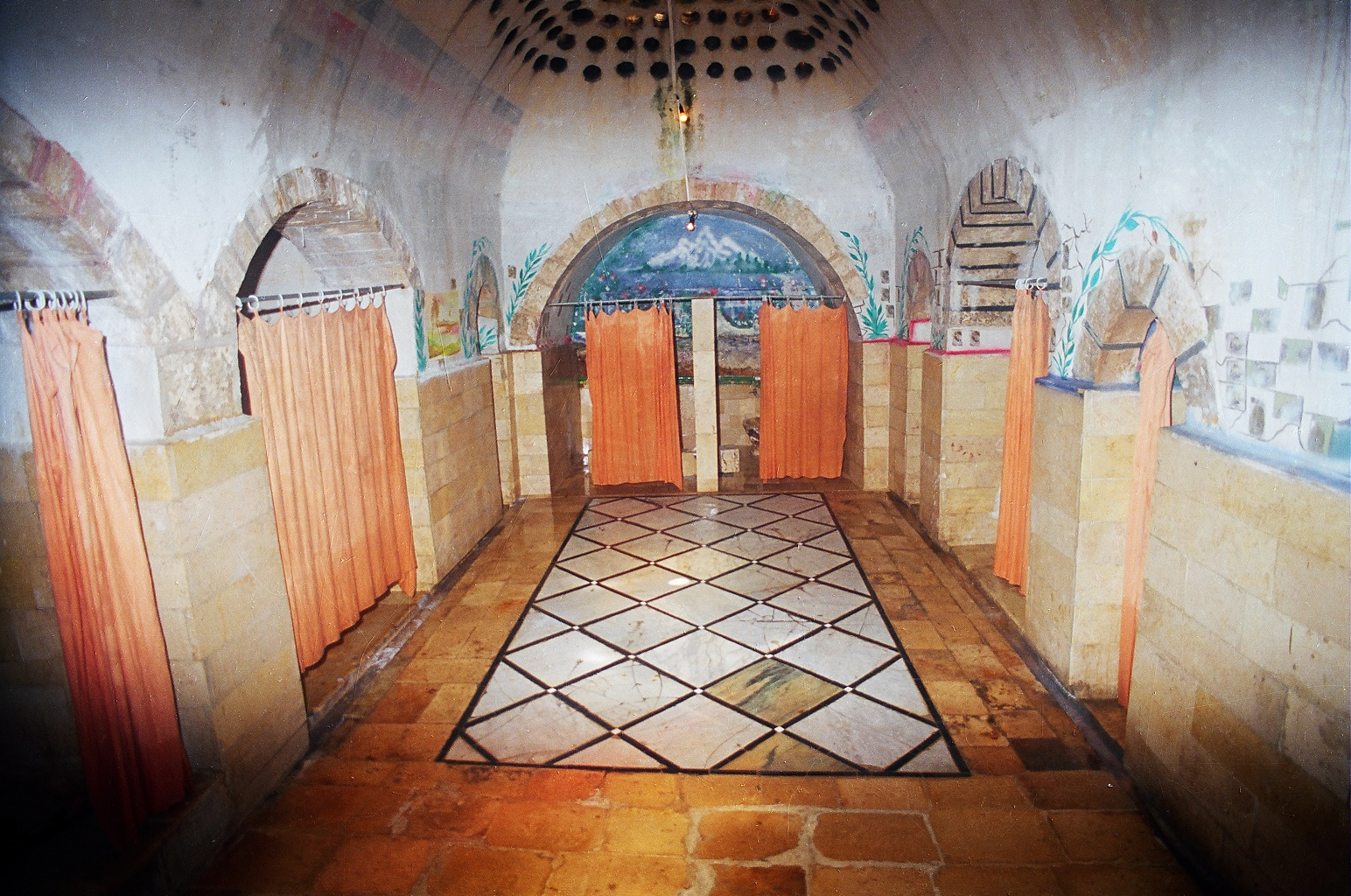
Figure (2): The bathing hall in the Al-Shifa Bath (Al-Jadidah)