
Yalla Falasteen
Revitalization Program
The Sanctuary of Rijāl al- ‘Amūd "Men of the Column"

The Sanctuary of Rijāl al- 'Amūd "Men of the Column" (Visiting time is open, free entry. It is advised to visit the site at the time of praying to ensure the possibility of entering it).
This Sanctuary is at the eastern end of the city. It is named after Sheikh Mohammad Amūd al-Nūr "Mohammad the column of light", a man from Hadramūt in Yemen, who came to Nablus in the early Islamic period. Then he was buried in the shrine together with his sons.
The shrine consists of several rooms: the room of the Imam who was called 'Ali, the room of privacy, the room of the presence, the room of prophet Shīth, the room of master Al-Khadr, the room of 'Ali from Damascus and a main hall that is topped by a vault which contains the tombs. There are several stone inscriptions inside the site. They denote its great religious importance.
Historical section
Attribution of the building (identification): The attribution of the building was helped by a group of written stone inscriptions inside the building and based on its architectural fabric: see history (below).
History: The western rooms of the building were likely founded at the beginning of the eighth century AH/fourteenth century AD during the Mamluk era, given that the stones of its construction are finely chiseled, its neck is polygonal and high, and its dome is circular and high, bearing the character and style of local construction that prevailed during this Mamluk era.
The written marble inscription above the threshold of the entrance located between the northern and southern rooms of the western rooms of the building states that the owner of this spacious space is Sheikh Amoud al-Nour, and thus it is considered evidence and a witness that is difficult to challenge. Another stone inscription, located above the niche of the southwestern prayer room of the western rooms, provides the study with detailed information about the building, its owner and his descendants, stating that Sheikh Amud al-Nour had built this room during his lifetime and endowed the surrounding land, known as the Haram al-Amud, to his descendants. It also states that the first person to be buried in this sanctuary was Sheikh Amud al-Nour himself, and after his death his sons, Sheikh al-Salih and Sheikh Saad al-Din, served his shrine. As for his third son, Sheikh Abdul Qadir, he was buried in Mecca. The inscription also states that the date of the shrine is 799 AH, the date of Sheikh Amud al-Nour’s death. At the same time, the date of writing this information is not recorded on this stone inscription, meaning that it is an undated inscription and is likely to have been written in the first half of the ninth century AH/fifteenth century AD. In short, Sheikh Amoud Al-Nour was one of the men of the eighth century AH/fourteenth century AD of the Mamluk era. During his lifetime, he built the prayer room and took it as his own corner. When he died, he was not buried inside it, but outside it, where the square known as the Haram is. That is why the first marble inscription was hung on the entrance outside it, where this wide space, i.e. the square, was explicitly mentioned. After his death, his sons, who inherited the residence in this corner, served his shrine. As a result, it is likely that they built or covered this square or space to become a shrine room for Sheikh Amoud Al-Nour and his sons, who were buried next to him after their death. It is understood from a third stone inscription above the small northern entrance to the northeastern room of the eastern rooms of the building that the one who renovated the dome of this room was Sheikh Saad Al-Din bin Saeed bin Abdul Qadir, and that was in the year 810 AH/1401 AD. That is, the one who renovated it was the grandson of Sheikh Amoud Al-Nour and the son of Sheikh Abdul Qadir, who was buried in Mecca. However, this dome was later demolished, as the first room is covered by a vault of a local construction style. Below this inscription is a fourth marble inscription above the aforementioned entrance, indicating that Prince Hussam al-Din Sunqur al-Suri al-Farsi had, in 892/1480 AD, endowed the land adjacent to this room to the north-east as a blessed soil for burying the dead Muslims. This makes the writer incline towards the fact that the demolition of the dome of this room and its re-roofing as a local vault took place at this time, and to confirm this, the aforementioned marble inscription was placed above its entrance and below the stone inscription. A little to the east of these two inscriptions, there is a small stone piece in which an inscription was engraved by Ali al-Dimashqi, whose lines are similar to the lines of the lower marble inscription, which suggests that Ali al-Dimashqi was the one who wrote and engraved the lines of this marble inscription in question. It appears that the south-eastern room most likely dates back to the tenth century AH/sixteenth century AD of the Ottoman era and is still known by the name of the shrine of Imam Ali.
The status of the pillar shrine among the people of Nablus
These shrines have gained a prestigious and respected status among the people of Nablus, as they were developed and this status was translated into religious and social customs and traditions that crystallized in the Ottoman era, where the people of Nablus began to perform the Eid prayers and the Istisqa prayer, and the Sufi men of the city would follow to the place accompanied by drums and flags, especially in the month of Shaaban.
Men of the Pillar in Historical Sources
The Men of the Pillar received a modest space from what was written by a group of those who were interested in the biographies of the Men of Nablus, we mention among them:
1. Sheikh Abdul Ghani Al-Nabulsi visited Nablus in 1101 AH/1689 AD where he said: “Then we headed to visit the forty prophets, the people of witnesses who are called Men of the Pillar, so we entered the cemetery of that country to a great burial place that includes many places, two and one, and in it is a cave, the top of which is in the form of a grave, and it has a window, which is the Cave of the Forty, and in that cave is a column, so that is why they were called Men of the Pillar. Then we sat for a period of time in that place and supplicated to God Almighty with whatever supplication we could, then we entered a place inside that burial place that is descended to by stairs called the shrine of Imam Ali, may God be pleased with him, in which there is a niche and upon it is his majesty and awe, perhaps he was seen there either in a dream or while awake, considering the manifestation in the world of illusions. What is noticeable here is Al-Nabulsi’s neglect of the content of the inscriptions and not using them as a reference for his information.
2. Al-Dabbagh in 1947 AD, and he repeated and transmitted what Sheikh Al-Nabulsi said later, and then he said after that that it is inferred from the stone inscriptions in it that it goes back to Sheikh Amud Al-Nour and his sons.
3. Al-Nimr in 1975 AD, who said: “It is most likely that they are the forty witnesses, who are the first Christian martyrs who were tortured by the pagans, and the column is called after Sheikh Amud Al-Nour who was buried in it, and he is from Hadhramaut, he came to the country as a mujahid and was buried in it, and with them was a generous Damascene man named Ali Al-Dimashqi. It is clear from what Al-Nimr said here that the first part of his speech is from the sayings and stories of the Samaritans that are not supported by evidence, and as for the second part of his sayings, it has no relation to the first part of it, and at the same time there is no evidence that Sheikh Amud Al-Nour is from Hadhramaut, and Al-Nimr is wrong when he believes that Ali Al-Dimashqi was a contemporary of Sheikh Amud Al-Nour, since Ali Al-Dimashqi was a calligrapher and writer and did not live with him and has no historical relationship with him.
Founder and builders: The nucleus of the building was founded by Sheikh Muhammad Amoud al-Nour in the eighth century AH / fourteenth century AD. In 810 AH / 1401 AD, Sheikh Saad al-Din bin Saeed Abdul Qader renovated the construction of the dome of the northeastern room. In 892 AH / 1480 AD, the adjacent to the eastern tomb was endowed by Prince Sunqur al-Suri al-Farsi. The descendants of Sheikh Amoud al-Nour contributed in the Ottoman era to building the southeastern room of the shrine. Later history (modern): The records of the Nablus Sharia Court indicate a number of cases of buying and selling of endowment lands endowed to the shrine by his descendants, who live in Nablus to this day and were in charge of supervising it and its endowments. They built a modern mosque in front of the shrine room inside the pillar grounds in 1990 AD, under the supervision of the Nablus Endowments Department.
Architectural Description
External Description: The wall of the two western rooms consists of small stones, and the length and width of the wall of each room is approximately 5 x 4 m, and its height is the same. The stones of the southern room appear older than the northwestern room, in which a small, simple northern entrance was opened. This is the room to the north of whose wall the newly built mosque is now attached to.
As for the two eastern rooms, they are separate from each other and are 3 m apart. The northern one is the largest of these rooms, as the length of its external wall north-south is 6 m and its width is 4 m. Its stone rows are interspersed with large, well-beaten stones. Its entrance is preceded by a northern corridor extending from east to west, covered by a barrel vault roof. In the middle of the southern side of it, and in the wall of the room, there is its small entrance. The southern room is small in size, measuring 3 x 3 m2, and it has small stone rows built. A photograph dating back to 1940 shows that the two rooms were connected by a simple stone wall that connected them to one external entrance, but the wall and the entrance were later demolished.
Internal description: A simple northern entrance leads to the northwestern room, in which there are three graves distributed on the western side. It is the shrine room covered by a locally styled vault and a simple dome. On the southern side there is a simple entrance topped by a marble inscription, leading to the prayer room where there is a stone niche on its southern wall topped by a stone inscription. The room is square in shape and covered by a circular dome that stands on an octagonal neck and is elevated above the surface of the room. The northeastern room is reached through an entrance opened in its northern wall. It is small and rectangular in shape, 1.5 m long and 3 m wide. It is topped by two stone and marble inscriptions in addition to a small inscription on which is the name of Ali al-Dimashqi. The floor plan of the room is square and does not contain any distinctive architectural elements. It is covered by a local one that probably dates back to the year 892 AH/1492 AD. A small eastern entrance leads to the southeastern room. It is a small, square room covered by a dome. To the northeast of these two eastern rooms is the public cemetery, but some modern vaults have now spread between all the rooms of the building and in front of the entrances to the rooms that make it up.
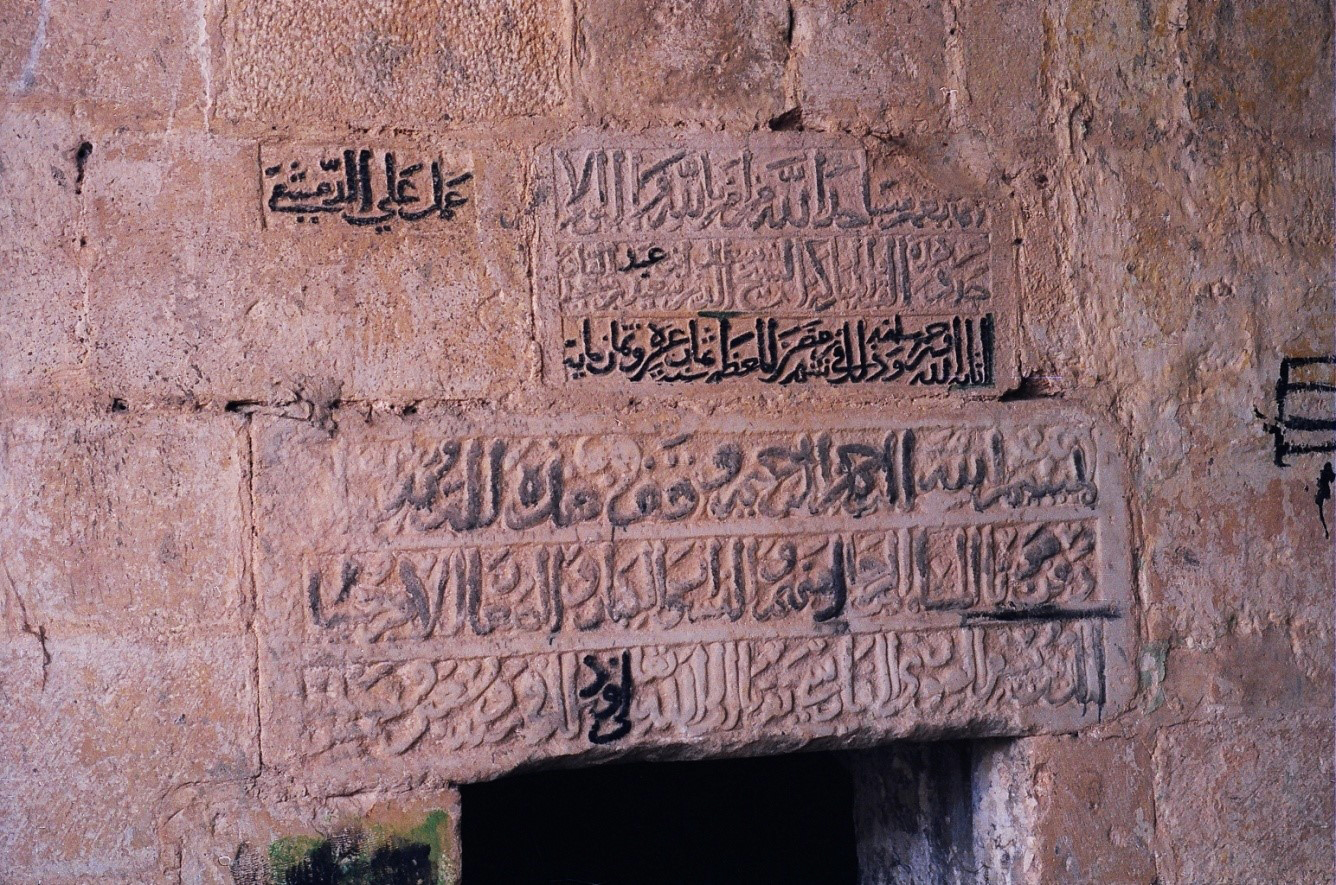
Figure (1): Inscriptions above the entrance to the northeastern room of the column shrine