
Yalla Falasteen
Revitalization Program
The Maqām of Sheikh Ghānim

The Maqām of Sheikh Ghānim (Visiting time 08:00 – 16:00, entry to the Maqām is through the Virgin Mary Church and is determined by the Israelis who charge fees for entry).
This Maqam is on the summit of mount Jarzeem at the south eastern end of the city. It is most probable that the man of the maqam is Ghānim Ibn 'Isa Ibn Mūsa ibn Sheikh Ghānim, who died in 1368 AD.
The Maqam consists of one room, with a high vaulted roof. In the southern internal wall of the maqam, a small Mihrāb is still present. The maqam overlooks the valley that includes a few parts of Nablus, as well as the 'Askar plains and the surrounding hills. It extends to the farthest north - eastern side of the Jordan mountains. This Maqam played a defensive role when the city was exposed to danger. It acted then as a lookout area. The building is under Israeli administration, the same as for the Virgin Mary church, and admission is required. From its northern end there is a view point from where visitors can see the east part of the city and the Jupiter temple.
Historical Section
Attribution of the building (identification): The attribution of the building was determined by analyzing its archaeological architectural fabric and by some Islamic historical sources that mentioned it with this name and attribution.
History: The archaeological architectural fabric of the shrine building indicates that its foundation and construction date back to the Roman-Byzantine period, and that it was originally one of the towers of the stone wall surrounding the newly discovered Church of the Virgin Mary, which was established in 484 AD by the Roman Emperor Zeno. In 493 AH/1100 AD, during the Frankish occupation of Nablus, the Frankish King of Jerusalem, Baldwin I, renovated and rebuilt the area as a Frankish castle to house soldiers and protect the city. However, this castle was later demolished by the Ayyubids, who liberated Nablus from the Franks in 583 AH/1187 AD. Thus, this tower was later used as an Islamic shrine. Historical sources indicate that before the shrine was known by this name and in relation to Sheikh Ghanem, it was known as the shrine, as the people of Nablus believed that the area was sacred and prayers were answered there. The Sheikh Ghanem to whom the shrine is attributed is Sheikh Ghanem bin Ali Al-Ansari, who had a corner in the village of Burin, where he lived for about twenty years. When Jerusalem was conquered, he traveled to Jerusalem and lived there for five years. Then he came to Damascus and remained there until he died in 632 AH/1232 AD, leaving behind many descendants who were known for their association with him. This means that Sheikh Ghanem Al-Ansari did not build or take any buildings or shrines in the city of Nablus, nor did he live or be buried in this shrine. Historical sources support this trend because they clearly indicate that it is linked to his son Sheikh Abdullah bin Ghanem, who was one of the most prominent sheikhs and was famous for his goodness, worship, and noble morals. God combined for him a good image, meaning, famous reputation, and beautiful monuments. Most of his residence was in Nablus, where he had a corner filled with poor and good visitors. He used to visit Jerusalem and frequent the place where he had a famous corner, followers, and disciples. He had virtue and knowledge of the path of the people. He ascended to the mercy and pleasure of God Almighty in Sha’ban of the year six hundred and seventy-two, when he was seventy years old, and was buried in At-Tur. It appears that Sheikh Abdullah had stayed at the site for worship, isolation, and sometimes for remembrance. This means that Sheikh Abdullah bin Ghanem was no less famous, famous, righteous, and established corners than his father Sheikh Ghanem. However, the corners established by Sheikh Abdullah became famous historically and were known by the name of his father Sheikh Ghanem, by way of attributing the son to his father and becoming famous by his name. The records of the Nablus Sharia Court mention that the dome of the shrine was renovated in the year 1101 AH/1689 AD, and that this was done by the trustee of the shrine’s endowment, Hajj Ghanem bin Hajj Mustafa Al-Alami. These records also mentioned in the same year that the well-known spring known as Ain Al-Kafir, located in the land of Al-Kafir in the lands of Rafidia and in the western suburbs of the city of Nablus, is among the endowments dedicated to the shrine of Sheikh Ghanem. This was mentioned when it was documented in its records that the trustee of the endowment, Hajj Ghanem bin Mustafa Al-Alami, had asked the judge of Nablus to inspect this aforementioned spring due to its deterioration, dryness, and need for renovation, where the judge ordered that it be renovated from the endowment’s money or borrowed if necessary. In the year 1135 AH/1722 AD, these records indicated that Sheikh Ghanem had descendants in Nablus who at that time became known as (Abu Shamat), in the context of recording a dispute lawsuit filed by Hajj Abdul Rahman Abu Shamat against Ali bin Hassan bin Saeed Abu Shamat, the trustee of the endowment of his grandfather Sheikh Ghanem. The subject matter was a land endowed to the shrine located in Jabal al-Tur.
The shrine in other historical sources
The site drew the attention of some travelers and historians, including:
1. The Turkish traveler Jalabi visited Nablus in 1082 AH/1671 AD, and said: “The shrine of Sheikh Ghanem Al-Maqdisi is located on a high mountain east of the city,” without adding any information related to the shrine or the true identity of its owner.
2. Sheikh Al-Nabulsi visited Nablus in 1101 AH/1689 AD, and mentioned it during his visit to the pillar shrine located east of Nablus without climbing the mountain to visit Sheikh Ghanem’s shrine, where he said: “And we recited Al-Fatihah for the grave of Sheikh Ghanem Al-Maqdisi and his son Sheikh Abdul Salam and those who were with them from the righteous.” However, Sheikh Al-Nabulsi made a mistake here, as it is historically proven that Sheikh Ghanem bin Ali Al-Ansari died and was buried in Damascus in 632 AH/1232 AD. While his son Sheikh Abdul Salam died and was buried in Egypt.
3. Sheikh Al-Laqimi, who visited Nablus in 1143 AH/1730 AD, and he mentioned him here as a possibility when he said: “It is possible that the owner of the grave is Ghanem bin Issa bin Musa bin Sheikh Ghanem, and that the one buried near him is his son Sheikh Abdul Salam.” This means that the Islamic cemetery next to the shrine in At-Tur had not been studied until this date, and Sheikh Al-Laqimi’s possibility here is incorrect, as Sheikh Ghanem bin Issa was the Sheikh of the Salahiyya Khanqah in Jerusalem and lived and was buried there in 770 AH/1368 AD, and Sheikh Abdul Salam is not his son, but rather the son of Sheikh Ghanem bin Ali Al-Ansari, who lived and was buried in Egypt.
The shrine according to modern researchers
The shrine was mentioned by:
1. Al-Dabbagh: He recorded here what was mentioned by the Turkish traveler Jalabi, Sheikh Al-Nabulsi, and Sheikh Al-Laqimi, then he finally preferred that the shrine is a corner belonging to Sheikh Abdullah bin Ghanem who died in 672 AH/1272 AD. In fact, Al-Dabbagh mentioned here the real person to whom the shrine is attributed, and this is true and not by way of preference.
2. Al-Nimr: He was satisfied with saying that Sheikh Ghanem “is not one of the saints, but rather one of the men of debate, and he was not buried here, but rather moved to Jerusalem and had strong descendants who built one of the minarets of Al-Aqsa. Al-Nimr means here Sheikh Ghanem bin Ali Al-Ansari who died and was buried in Damascus in 632 AH/1232 AD. At the same time, Al-Nimr did not provide any opinion here about the real person to whom the shrine is attributed.
3. Al-Abadi: Here he recorded historical information intertwined with explanation and understanding about the personality of the owner of the shrine, then he added that the shrine was built as a watchtower, and was used as a residence and a corner. However, the tower was a Roman building that existed before it was used as an Islamic shrine, and Al-Abadi's words are a kind of extended construction far from many historical facts and those specific to the shrine and its owner.
The founder and the long-lived: No information was available about the founder or the long-lived.
The later history (modern): The written stone inscription located above the southern facade of the shrine states that it was built in 1965 AD by the Nablus Antiquities Department.
Architectural description
External description: The shrine is a square-shaped building, with four high-construction external walls, and the stones of the lower section of these walls are characterized by being large in size and of the type that was prevalent in the Roman era. The upper part of these four walls is mostly made up of small stones, which means that the upper part of the shrine tower was rebuilt, most likely during the Ottoman era. The upper southern wall of the shrine is characterised by the presence of small windows, one single window and two double ones, while the western wall of the shrine overlooks a small western courtyard in which there is a group of studied Islamic graves (Figure (1)). Through this courtyard, one can reach the entrance to the shrine located below the western wall, which is a small entrance about two metres long and one metre wide.
Internal description: The only western entrance to the shrine leads to a square-shaped lower room measuring 4 x 4 m2 and devoid of any architectural decorative elements. However, in its southern wall there is a small niche in the form of a stone niche measuring 1 m long, 70 cm wide and 50 cm deep. This room is covered by a flat roof, and in its western corner there is an iron staircase leading to the upper room, which is the same size as the lower room but is covered by a shallow dome 2 m above its floor. The architectural fabric of these two rooms indicates that they form a single architectural unit like a square stone tower despite the different historical architectural stages that it went through.
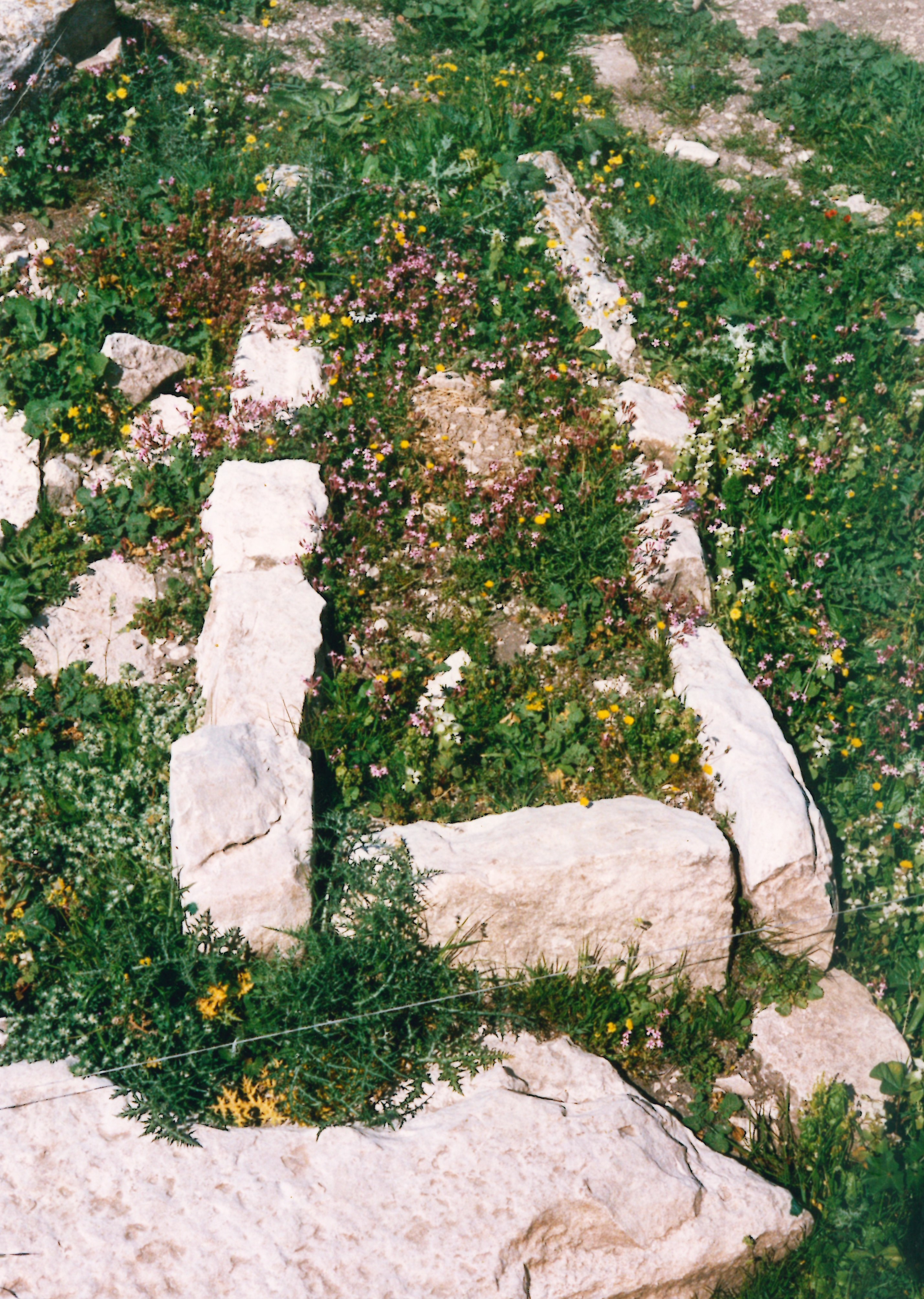
Figure (1): An Islamic grave that was removed as a result of Israeli excavations, adjacent to the shrine of Sheikh Ghanem.