
Yalla Falasteen
Revitalization Program
The Byzantine Ruins - Jacob's Well Church (Bir Yaqūb)

Jacob's Well Church (Bir Yaqūb) (Visiting time 10:00 -12:00, and 14:00 -16:00, free entry, donations are welcomed).
It is located on top of Jacob’s well, hence its name. It is in the eastern part of the city; Jacob's Well Church is the most important religious building for Christians in Nablus. It is the site that dates from the time when Jesus Christ asked the Samaritan woman to give him water to drink; the story is from Genesis chapter 29 verses 1-10, and that of the Samaritan woman from John’s Gospel ch4 vv5-30.
It is believed that the church on the well was founded by St. Helena, the mother of emperor Constantine, in 365 AD. Another belief argues that the church was originally built around 1132, and it was rebuilt between 1169 and 1173. Only the foundations of the present building date back to the Crusader period. Most of the church had been destroyed in 1572. Work on the present church had begun in 1908, but it was interrupted by the start of WWI in 1914. The current church building was completed by Father Justinus Mamalus, who devoted 30 years of his life to building the church until it was officially opened in 2003. The modern building includes pillars and capitals from various architectural styles. The building dominates the Balata area with frescoes, gold decorations and a splendid red-tile dome besides two towers.
The well of Jacob itself is underneath the main church, and it is accessed by a steep flight of stairs in the ancient underground chapel. The well shaft is believed to be over 40 m. deep and the water is naturally very cold and clear.
To the left-hand side of the well, there is the tomb of archimandrite Philoumenos Khassapis, who was beaten to death by an Israeli settler in 1979 who wanted to Judaize the site.
History of the Church
The reason for building this church over Jacob's Well is to commemorate the meeting of Jesus Christ with the Samaritan woman during his journey from Jerusalem to Galilee, when he was tired and sat next to this well, and when a Samaritan woman came to draw water, he asked her for a drink of water to drink, so she said to him: How do you ask me for water to drink while you are a Jew, and I am a Samaritan woman because Jews do not deal with Samaritans. Pringle believes, based on this account, that it is likely that this well became a place of baptism for Christians in the year 330 AD. During the reign of Emperor Constantine the Great (324-337), in the year 384 AD a Byzantine church was built over the well, but it was destroyed during the Samaritan revolt at the hands of the Romans in the year 484 AD, or in the year 529 AD. Therefore, Emperor Justinian (527-565 AD) rebuilt it and increased its decorations. This is the church that Arculf described in the year 670 AD and which remained standing until the year 720 AD or a little after, as Bishop Willibald saw this church in the eighth century AD. When the Franks occupied the city of Nablus in 1099, the diaries of travelers such as Saioulf (1101-1103 AD) and Daniel (1106-1108 AD) supported the absence of a church, despite their mention of the well. However, based on the testimony of Al-Idrisi, who mentioned a beautiful church on Jacob’s Well in 548/1175, and the description of the pilgrim Theodoric of the construction of a church on Jacob’s Well in 1175, and a reference to documents related to land exchanges in 573/1148, this indicates that a church was built on Jacob’s Well at the end of the Frankish period. However, it appears that this Frankish church was not built, as we do not find any mention of it in the traveler Burshader, who lived in Palestine for a long time. He mentioned Jacob’s Well in his writings in 1283 AD and did not mention any construction of any church that was standing on it at that time, which means that this church was demolished or destroyed during the confrontations. The liberation of Nablus by Saladin in 583/1187. Although the church and its area were destroyed, the Franciscans in the fourteenth century AD learned about the place by holding a mass in the basement located under the destroyed church every year. Later in the following century, travelers found it difficult to identify the well. In 1860 AD, the Greek Orthodox Patriarchate was able to buy the site, and thus in 1893 AD archaeological excavations began in the area, the aim of which was archaeological research rather than searching for the place on which the church was located. In 1914, the reconstruction of the Frankish Church began, but this work stopped due to World War I, when half of the walls were built. Recently, on 5/17/1998 AD, its construction was completed by those in charge of the affairs of this church.
Archaeological Description
1. The Well
The well is located at the eastern end below the current church building, inside a semi-barrel vault that is reached through the church, where it is descended by stone steps on both sides of the northern and southern vault from its western facade. The well is located in the middle of this vault, which is a stone building with a cylindrical shape, 32 m deep. It is possible that it was deeper than that, but it seems that some of the ruins of the previous church were placed in it.
2. The Church
Archaeological research indicates that the Frankish church that was located on the site included a basilica-style building consisting of three aisles, the largest of which is the central aisle leading to the western entrance, facing it to the east is a large main apse and a large dome, and on each of its northern and southern sides is another smaller apse, at each of which there is a stone staircase leading to the vault in which the well is located (Figure (1)). This church had high walls built with well-carved stones, and inside it were stone columns and supports, with a stone support attached to its facades, stone columns standing on high square stone bases to raise the columns topped with Corinthian capitals. It is likely that this was the layout and shape of the previous Byzantine church, which took its layout from the Roman basilica system. As for the church, which was not completed in 1914 AD, it was also designed according to the Frankish church system and its construction bears many architectural elements of the previous Frankish church, whether in its stones or columns. It is worth noting that outside the current church building, on the southeastern side of it, there is a piece of mosaic, which was restored with the help of the Nablus Antiquities Department in 2011 AD, and it is believed to be from the remains of the Byzantine church.
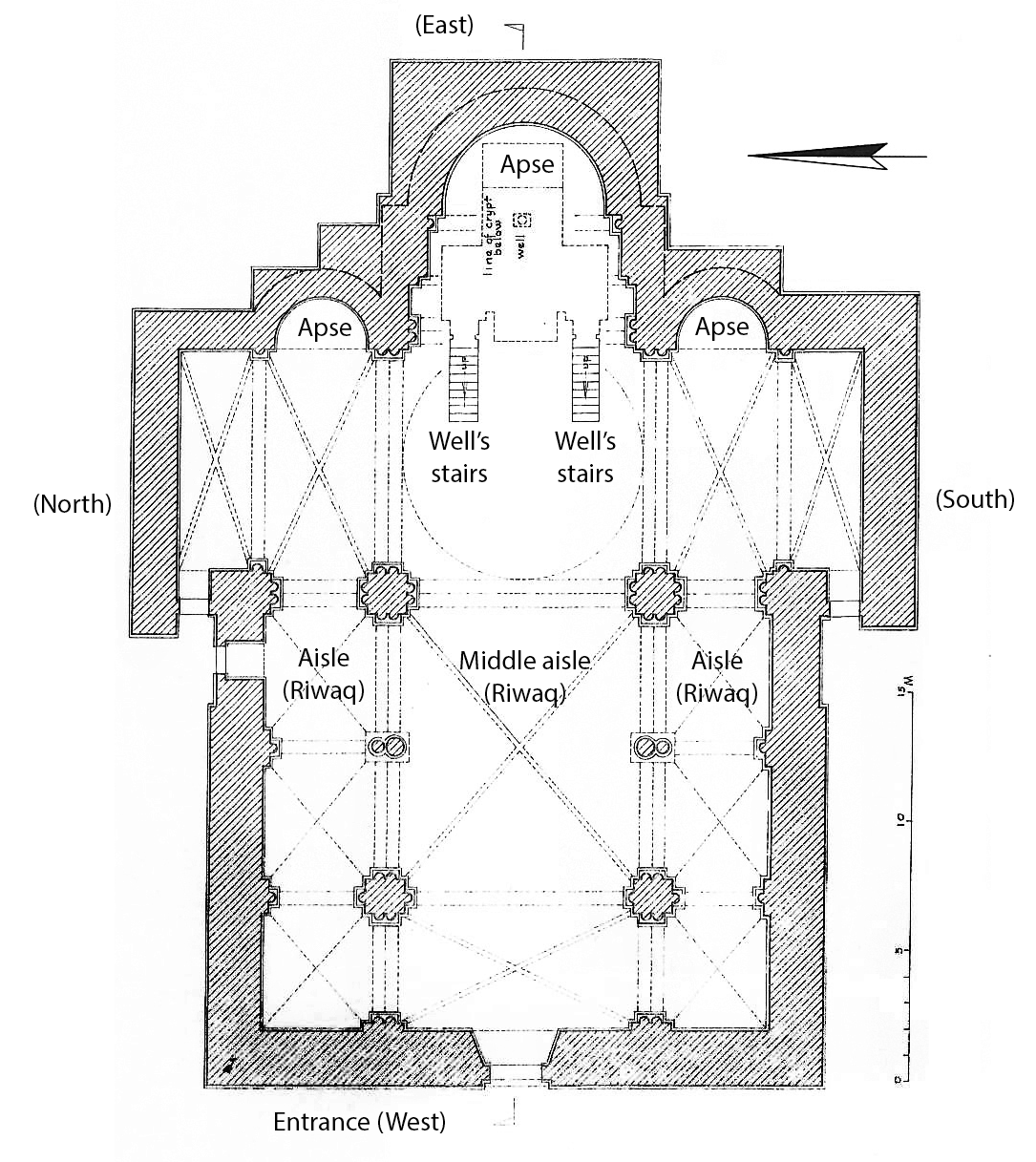
Figure (1): Plan of the Frankish church above Jacob’s Well, which is believed to have been similar to the plan of the Byzantine church.